
Why Money Disappears Then Reappears in Bank Account
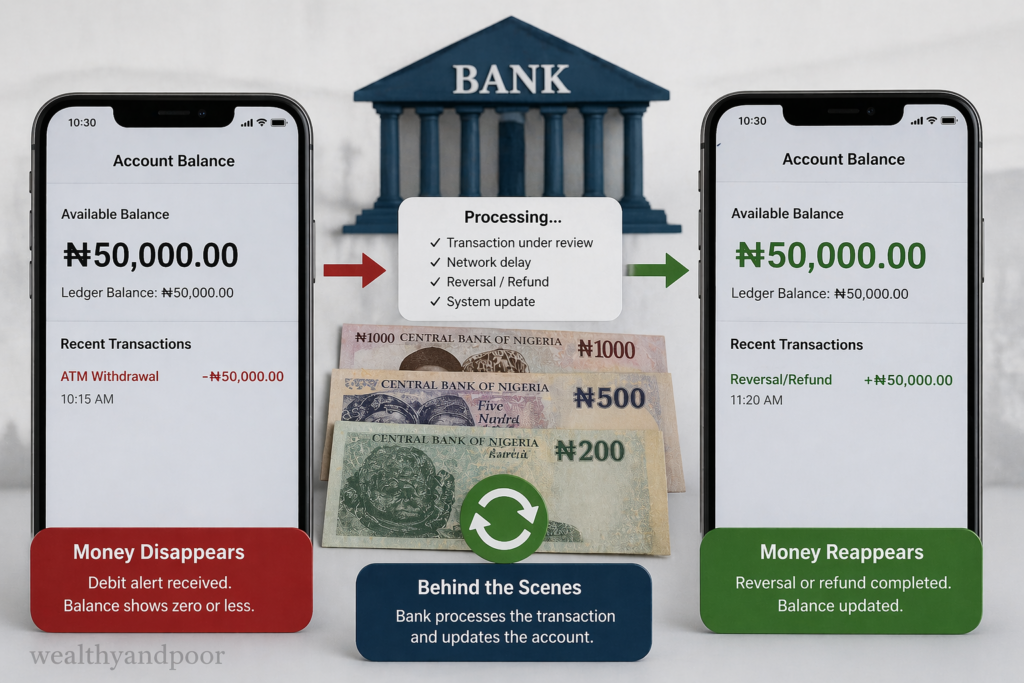

For many bank customers, few experiences are as unsettling as watching money “vanish” from an account only to reappear hours or days later. In Nigeria’s fast growing digital banking ecosystem, this phenomenon is increasingly common, especially with the surge in mobile transfers, POS payments, and online transactions.
But contrary to popular suspicion, this is rarely a case of money being stolen or lost. Instead, it reflects how modern banking systems process transactions behind the scenes often in ways that are invisible to users.
The Illusion of Disappearing Money
At the heart of this issue is a misunderstanding of how banks handle transactions. What appears to be a sudden loss or return of funds is usually a transition between different stages of payment processing: authorization, pending status, and final settlement.
When you initiate a payment whether through a debit card, transfer, or USSD the bank does not instantly complete the transaction. Instead, it places a temporary hold on your funds. This stage is known as a pending transaction, meaning the money is earmarked but not yet fully transferred.
During this phase, your available balance drops, giving the impression that money has left your account. However, the transaction is not yet final.
Authorization Holds: The Main Culprit
The most common reason money disappears and reappears is authorization holds.
When you make a payment, the merchant requests approval from your bank to ensure you have sufficient funds. Once approved, the bank temporarily blocks that amount.
However, if the merchant delays completing the transaction or fails to finalize it within a specific period the bank may remove the hold. When this happens:
- The transaction disappears from your account history
- Your balance increases again
- It appears as though your money has “returned”
But this is not the end of the story.
If the merchant later submits the final charge, the transaction will reappear this time as a completed debit.
This cycle hold, disappearance, and reappearance is one of the most frequent causes of confusion among banking customers.
Delays in Payment Processing
Another major factor is processing delays between banks and merchants. Even though digital payments feel instant, they often involve multiple institutions:
- Your bank
- The merchant’s bank
- Payment networks or switching systems
Each of these parties must confirm and reconcile the transaction before it is finalized. If any step is delayed, the transaction may temporarily vanish or appear inconsistent.
In Nigeria, this is further complicated by infrastructure challenges. According to , high transaction volumes, network failures, and interbank settlement issues can all slow down processing.
This can result in:
- Temporary debits without confirmation
- Delayed transaction alerts
- Reversals that take hours or days
- System Glitches and Synchronization Errors
While banking systems are highly sophisticated, they are not immune to technical issues.
Sometimes, transactions disappear due to:
- Temporary server downtime
- App synchronization problems
- Software updates or maintenance
In such cases, the issue is usually visual rather than financial the transaction still exists in the bank’s core system but is not properly displayed in your app or account interface.
Once the system stabilizes, the transaction reappears automatically.
Batch Processing and Timing Differences
Despite advances in real time payments, many transactions are still processed in batches rather than instantly.
This means:
- Transactions are grouped together
- Processed at specific intervals
- Posted to accounts later
As a result, a transaction may briefly disappear during reconciliation, only to reappear once processing is complete.
Timing also matters. Transactions initiated:
- Late at night
- On weekends
- During public holidays
may experience delays before final posting, increasing the likelihood of temporary inconsistencies.
Debit Card Transactions vs Transfers
Interestingly, this issue is more common with debit card payments than direct bank transfers.
This is because debit card systems rely heavily on authorization holds before settlement
In contrast, bank transfers especially instant transfers are more straightforward, although they can still be affected by network congestion or interbank delays.
When Should You Be Concerned?
While disappearing and reappearing money is usually normal, there are situations where it warrants attention:
- The transaction does not return after several days
- The final amount is different from the original
- You notice duplicate charges
- The transaction is unfamiliar
In such cases, it is advisable to contact your bank immediately and request a transaction trace or reversal.
The Bigger Picture: Trusting the System
What feels like a glitch is often a reflection of how banking systems are designed to prioritize security, accuracy, and fraud prevention over speed.
Every transaction goes through multiple checks to ensure:
- The sender has sufficient funds
- The transaction is legitimate
- Both banks agree on the transfer
This layered process can create temporary inconsistencies, but it ultimately protects customers from errors and fraud.
Conclusion
The phenomenon of money disappearing and reappearing in a bank account is less about mystery and more about mechanics. It stems from authorization holds, processing delays, system synchronization, and the complex journey money takes between institutions.
For customers, the key takeaway is simple: your money is rarely lost it is usually just in transit.
Understanding this can reduce panic, improve financial awareness, and help users navigate digital banking with greater confidence.












Comments