
Why Banks Charge for Transfers
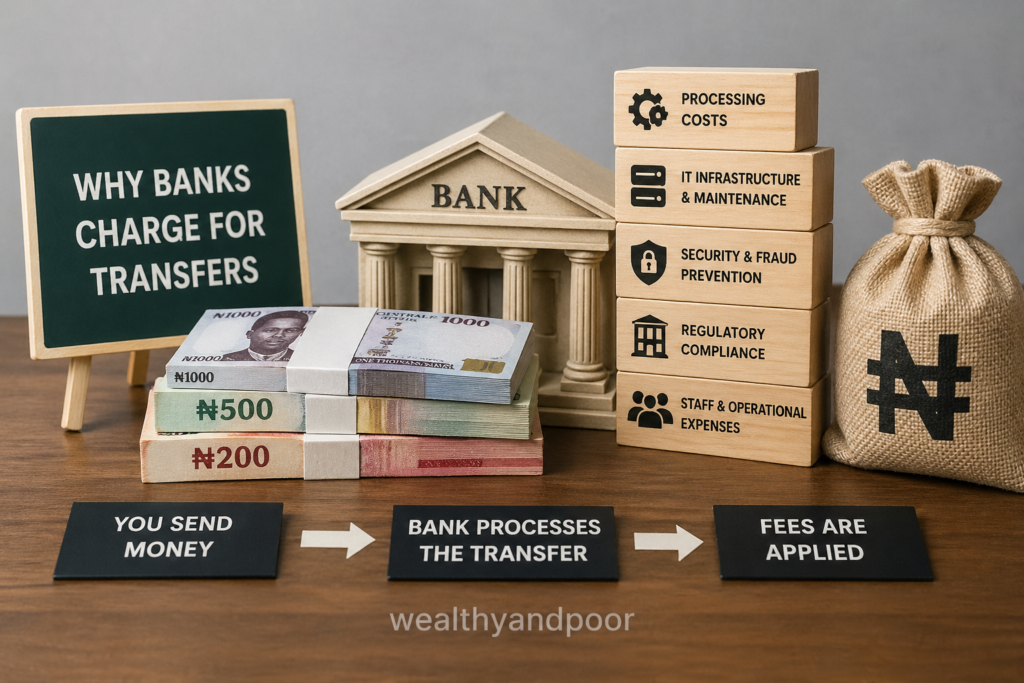

In today’s increasingly digital economy, bank transfers have become one of the most common ways to move money. Whether paying for groceries, settling bills, or running a business, millions of transactions happen daily with just a few taps. Yet, one question continues to frustrate many users: why do banks charge for transfers at all?
The answer is more complex than it appears. Bank transfer charges are not simply arbitrary deductions; they are rooted in a combination of operational costs, regulatory policies, infrastructure maintenance, and government imposed levies. Understanding these layers helps explain why even small transactions can attract fees.
The Cost of Running Payment Infrastructure
At the heart of every bank transfer is a sophisticated financial network. Transfers are processed through systems that connect multiple banks, payment switches, and settlement platforms. In Nigeria, this ecosystem is largely supported by institutions like the Nigeria Inter Bank Settlement System (NIBSS), which ensures that money moves securely and instantly between banks.
Maintaining this infrastructure is expensive. Banks invest heavily in:
- Secure servers and data centers
- Fraud detection systems
- Real time transaction processing technology
- Customer support and dispute resolution
These systems operate 24/7, ensuring that transfers are fast and reliable. The fees charged per transaction help banks recover these operational costs while maintaining service quality.
Regulatory Charges and Government Levies
A significant portion of what customers perceive as “bank charges” does not actually go to the bank. Instead, it is mandated by government policy.
One of the most notable examples in Nigeria is the ₦50 charge on transfers of ₦10,000 and above. This fee, often misunderstood, is a government levy (now structured as stamp duty) that banks merely collect on behalf of authorities.
Recent policy updates have reinforced this structure. From 2026, this ₦50 charge is paid by the sender rather than the receiver, adding to the visible cost of transactions.
In addition to stamp duty, other statutory charges may apply:
- Value Added Tax (VAT) of 7.5% on service fees
- Cybersecurity levy (a small percentage on electronic transactions)
- Other regulatory compliance costs
Together, these charges significantly increase the total amount deducted per transfer.
Standardized Bank Fees
Beyond government levies, banks also charge their own service fees. In Nigeria, these fees are largely standardized under guidelines from the Central Bank of Nigeria (CBN), meaning most banks charge similar amounts.
Typical fee structures include:
- ₦0 for transfers below ₦5,000 (recent policy updates)
- ₦10 for transfers between ₦5,000 and ₦50,000
- Up to ₦50 for transfers above ₦50,000
These charges are designed to balance affordability with sustainability. Lower fees for small transactions encourage financial inclusion, while higher-value transfers help banks recover more costs.
Encouraging a Cashless Economy
Another key reason banks charge (and structure) transfer fees is to influence behavior. Governments and regulators often use pricing as a tool to promote digital payments over cash.
In Nigeria, recent CBN policies have reduced or eliminated fees on small transfers specifically to encourage everyday users especially traders and small businesses to adopt electronic payments.
By contrast, slightly higher fees on larger transactions ensure that the system remains financially viable without discouraging usage.
Security and Risk Management
Every transfer carries a level of financial risk. Banks must ensure that transactions are:
- Protected against fraud
- Accurately processed
- Reversible in cases of error (where possible)
To manage these risks, banks invest in cybersecurity systems, encryption technologies, and compliance frameworks. They also maintain teams dedicated to monitoring suspicious activity and resolving disputes.
These protective measures are not free. Transfer fees help fund the systems that keep customers’ money safe in an increasingly digital and fraud-prone environment.
The “Fee Stack” Effect
One of the main reasons customers feel overcharged is not necessarily the size of individual fees, but how they accumulate.
A single transfer might include:
- Bank transfer fee
- ₦50 stamp duty (for qualifying transactions)
- VAT on the service fee
- Minor additional charges
Individually, these amounts seem small. Combined, they can make a simple transfer feel expensive especially for users who transact frequently.
This layering of charges creates what many financial analysts call a “fee stack,” where multiple small deductions add up to a noticeable cost.
Global Perspective: Why Fees Exist Everywhere
Nigeria is not unique in charging transfer fees. Around the world, banks impose fees for similar reasons covering infrastructure, managing risk, and maintaining profitability.
For example, international wire transfers often attract significantly higher fees because they involve multiple banks and currency conversions. In such cases, each intermediary institution may take a portion of the transaction cost, further increasing the total fee.
This global pattern highlights a key reality: moving money securely and instantly is a complex service, and fees are part of sustaining that system.
The Future of Transfer Fees
While fees are unlikely to disappear entirely, their structure is evolving. Regulators are increasingly pushing for:
- Lower costs on small transactions
- Greater transparency in fee breakdowns
- Increased competition from fintech platforms
These changes aim to make digital payments more accessible while still ensuring that banks and payment providers can operate sustainably.
Conclusion
Bank transfer charges are not simply a way for banks to make extra money they are the result of a layered system involving operational costs, regulatory policies, and government-imposed levies. From maintaining secure payment infrastructure to collecting taxes like stamp duty, each fee serves a specific purpose.
However, the real issue for many users lies in transparency. When multiple small charges appear without clear explanation, trust can erode. As financial systems continue to evolve, clearer communication and smarter pricing models will be key to balancing convenience, affordability, and sustainability.












Comments