
Hidden Taxes Nigerians Pay Without Knowing

Many Nigerians believe the only taxes they pay are personal income tax or company tax deducted from salaries and business profits.
However, a large number of indirect charges are often embedded in banking transactions, phone services, government levies, and everyday financial activities.
Hidden taxes are essentially indirect government levies collected through financial institutions, telecom companies, and service providers. While these deductions are legal and contribute to government revenue
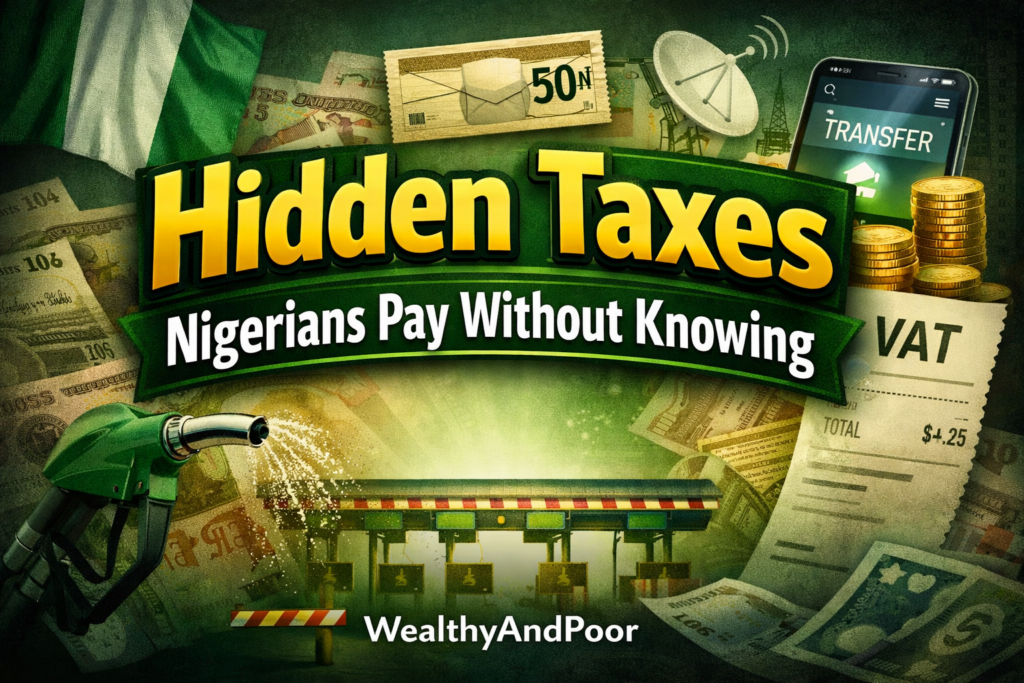
One of the most common hidden taxes Nigerians pay is stamp duty on electronic transfers. Whenever a bank transfer of ₦10,000 or more is received, a ₦50 charge is deducted as stamp duty. Many people assume this deduction belongs to the bank, but it is actually a government levy collected on behalf of the Federal Inland Revenue Service (FIRS). The charge applies to transfers between individuals, payments for goods and services, and other electronic transactions. Over time, frequent transfers mean Nigerians collectively pay billions of naira in stamp duty every year.
Another hidden tax appears in mobile phone usage. Telecom subscribers pay a variety of small regulatory charges embedded in the cost of airtime and data bundles. These charges support industry regulation and infrastructure development overseen by the Nigerian Communications Commission (NCC). While these deductions are not always itemized on recharge receipts, they are included in the pricing structure of telecom services. This means every call, SMS, or data purchase indirectly contributes to government revenue.
Banking services also contain several small charges that function similarly to hidden taxes. For instance, electronic banking transactions sometimes include regulatory or processing fees that are partly remitted to the government. Policies guiding these charges are often influenced by the Central Bank of Nigeria (CBN), which regulates financial institutions and sets frameworks for banking operations. While banks implement the charges, a portion of the revenue ultimately supports regulatory oversight and financial system management.
Another example is Value Added Tax (VAT), which is quietly embedded in many goods and services Nigerians purchase daily. VAT is currently charged on items such as restaurant bills, hotel stays, professional services, and some digital services. Instead of paying VAT directly to the government, consumers pay it as part of the total price of goods or services. Businesses then remit the tax to the government. Because VAT is already included in the final bill, many Nigerians do not realize they are paying tax each time they make a purchase.
Utility payments can also contain hidden tax elements. Electricity bills sometimes include regulatory or administrative charges approved by government authorities. While these charges are necessary for maintaining infrastructure and regulation, they are often bundled into the total amount customers pay, making them difficult to identify individually
Vehicle owners are also affected by hidden taxes through road-related payments. Charges such as vehicle registration fees, road worthiness certificates, and driver’s license renewals are technically government levies tied to transportation services. Because they are paid periodically and often processed through agencies or third parties, many people see them simply as administrative costs rather than taxes.
In addition, import duties and tariffs on foreign goods also operate as hidden taxes on consumers. When businesses import products into Nigeria, they pay customs duties and levies before the goods are released. These costs are usually passed on to consumers through higher retail prices. As a result, Nigerians indirectly pay import taxes whenever they buy certain electronics, clothing, or imported household goods
While hidden taxes may seem insignificant individually, they accumulate over time and across millions of transactions. For the government, they represent an important source of non-oil revenue used to fund public services, infrastructure projects, and administrative operations. For citizens, however, the lack of visibility around these deductions often leads to confusion and frustration.
Greater financial transparency and public awareness are important in helping Nigerians understand how these deductions work. When citizens know which charges are government taxes and which belong to service providers, they can better manage their finances and make informed decisions about transactions and services they use.
In conclusion, hidden taxes are a normal part of modern economic systems, especially in countries trying to broaden their revenue base beyond oil. But awareness is key. The more Nigerians understand these everyday deductions, the better they can track their spending and appreciate how small financial charges contribute to national revenue generation.







Comments