
Tier 1 Account Limits In Nigeria ( 2026)
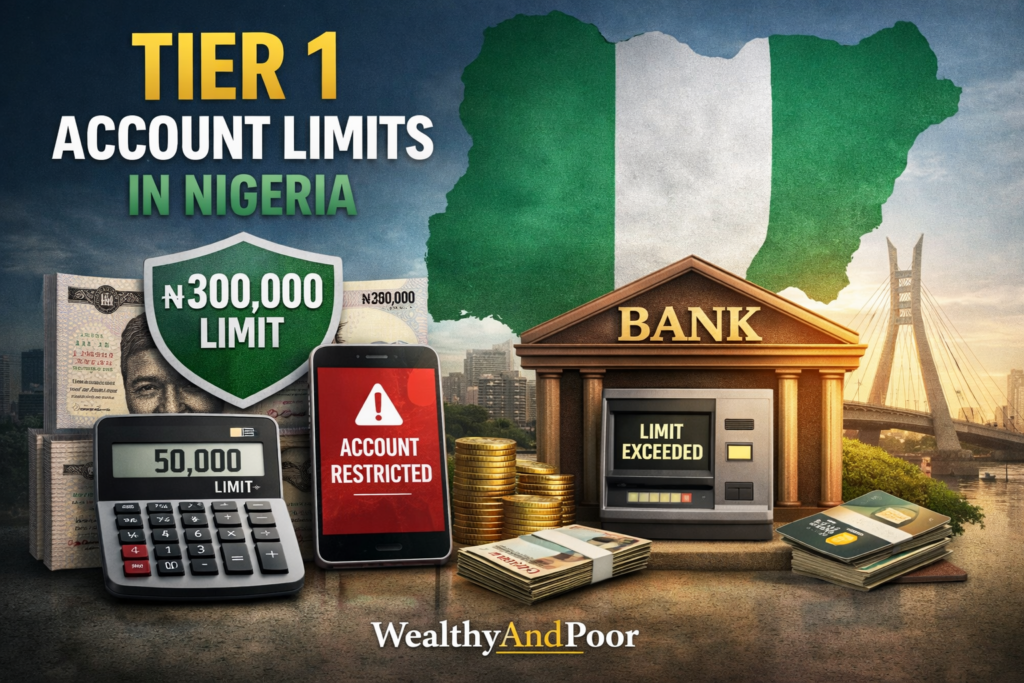

A Tier 1 account is the most basic level of bank account under the Central Bank of Nigeria’s (CBN) three-tiered Know Your Customer (KYC) framework. It was introduced to make banking more accessible by allowing Nigerians to open accounts with simplified identity verification and lower transaction thresholds. For many people, this is the first point of contact with the formal banking system.
Tier 1 accounts are widely used by students, small business owners, traders, artisans, and players in the informal sector who need a functional bank account without the stress of extensive documentation. With just a BVN and basic personal details, account holders can receive money, make transfers, pay bills, and carry out everyday transactions.
However, this convenience comes with a major condition that many account holders only discover late: transaction and balance limits.
Understanding Tier 1 account limit as a holder is necessary as the economy cashless policy will continue to expand in 2026.
Why Tier 1 Account Limits Exist
The limits placed on Tier 1 accounts are part of Nigeria’s broader effort to balance financial inclusion with financial security. While the CBN encourages access to banking services, it also requires banks to manage risks related to fraud, money laundering, and identity abuse.
Tier 1 limits ensure that customers can perform everyday transactions while reducing systemic risk.
Maximum Account Balance: (₦300,000). This means a Tier 1 account cannot hold more than ₦300,000 at any point in time. If an incoming transfer will cause the balance to exceed this limit, the transaction may fail or be reversed automatically.
Transaction Limits
While transaction limits may vary slightly depending on the bank, Tier 1 accounts generally have the following restrictions:
- Single deposit limit: Usually capped around ₦50,000
- Daily transaction limit: Often restricted to ₦50,000 total
Common Problems Tier 1 Account Holders Face
Many Nigerians only become aware of Tier 1 limits after encountering problems such as:
- Failed incoming transfers
- Reversed deposits
- Inability to receive business payments
- Temporary account restrictions
In most cases, these issues are not caused by poor network service or bank inefficiency. They occur because the account has reached or attempted to exceed its regulatory limit.
Tier 1 accounts are well-suited for individuals with low to moderate transaction volumes, including:
- Students and NYSC members
- Small traders and artisans
- First-time bank users
- Individuals with occasional income streams
People seeking a secondary or savings account
What You Can Do
- Receive small payments and transfers
- Send money within approved limits
- Pay bills, buy airtime, and subscribe to services
- Save funds up to ₦300,000
What You Cannot Do
- Hold balances above ₦300,000
- Carry out frequent high-value transactions
- Easily access loans or credit products
- Run medium or large-scale business operations
How to Upgrade a Tier 1 Account
Upgrading from Tier 1 to Tier 2 or Tier 3 is usually straightforward and can be done through a bank’s mobile app, customer service channels, or physical branches.
Common requirements include:
- Linking a National Identification Number (NIN
- Providing a valid means of identification
- Address verification for Tier 3 accounts
Once verified, the account limits are adjusted automatically.
Frequently Asked Questions
Q1. Can I receive ₦500,000 in a Tier 1 account?
No. Your balance must not exceed ₦300,000 at any point.
Q2. Do all Nigerian banks follow the same Tier 1 rules?
Yes. The limits are regulated by the Central Bank of Nigeria.
Q3. Is Tier 1 account safe?
Yes. It offers the same security as other account tiers, just with lower limits.
Q4. Can I run a business account as Tier 1?
Only very small, low-volume operations. Growing businesses should upgrade.
In Conclusion: Tier 1 accounts remain an important part of Nigeria’s banking ecosystem, providing millions of Nigerians with access to basic financial services. However, they are not designed for high-volume transactions or growing financial needs.
As 2026 approaches, understanding Tier 1 account limits is essential for avoiding failed transactions, payment delays, and unnecessary frustration. For many users, hitting these limits is not a setback—it is a signal that financial activity is growing and an upgrade is due.
For Nigerians looking to bank smoothly in the coming year, staying informed and upgrading when necessary will be key to uninterrupted financial access.











Comments