
Why piggyvest Failed to Debit Your Card

PiggyVest is a digital savings and investment platform that allows users to fund accounts via debit cards and perform other banking functions. When a user initiates a card funding transaction (e.g., adding funds to Flex Naira or Safelock), PiggyVest’s system communicates with external payment processors — historically Paystack, Flutterwave and others — which in turn communicate with the issuing banks. Problems arise when this multi-party chain experiences disruptions.
Funding via debit card on PiggyVest required middlemen like Paystack or Flutterwave. These services authenticate the card, verify the transaction, and instruct the bank to debit the user’s account. If any party in that chain experiences downtime or issues, the entire debit request can fail or stall. PiggyVest’s own terms state that payment disruptions caused by failures in the Nigeria Inter-Bank Settlement System (NIBSS), payment partners, or banking partners may lead to delays and failed debit attempts — and the company is not liable for these.
NIBSS and Settlement System Delays
In Nigeria, most electronic payments — especially inter-bank and fintech transactions — are routed through the NIBSS platform. When NIBSS experiences technical glitches, slow processing, or maintenance downtime, transactions may not complete. As described in PiggyVest’s user terms, payment delays and failures can result from disruptions in systems outside the company’s direct control.
Technical Glitches and System Errors
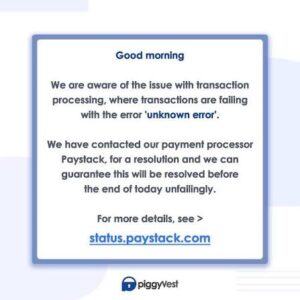
A significant number of failed debits are not due to bank or user error, but system-level glitches within PiggyVest or among its partners.
- Network Error’ Incident: In May 2025, thousands of PiggyVest users were locked out of transactions due to persistent “network error” messages on the app and website. This error prevented users from accessing accounts and processing transactions for hours. Many frustrated users reported that payouts, withdrawals, and card debits could not be initiated during this downtime. PiggyVest later confirmed that a technical outage caused the problem and that it was resolved.
- Temporary Balance and Sync Issues: In June 2025, another technical glitch caused funds to temporarily disappear from user balances, prompting panic across social platforms. PiggyVest acknowledged the issue, apologized, and reassured users that affected balances were being restored. Although not directly payment failures, such system inconsistencies can indirectly affect card debits (e.g., if the app fails to verify available balance due to a sync error).
- Banking and Card-Level Issues: Sometimes failed debits are triggered by factors beyond PiggyVest’s platform: your own bank or card settings.
- Card Authorization and Fraud Controls: When you save a debit card on an app like PiggyVest, banks and card issuers employ fraud detection systems. If the issuer deems a transaction suspicious, they block or decline the debit request. This is especially common for online fintech charges and automated debits. Many online communities have reported card declines even when OTPs (one-time passwords) are received, due to automatic fraud-side blocking by banks.
- Card Activation and Permissions: Before a debit can occur, your bank must enable online or e-commerce transactions on the card. If this setting is disabled, even a correct card number with adequate funds will be rejected by the processor, and the debit will fail. This is a common check for Nigerian-issued cards that are not configured for internet transactions.
- Insufficient Funds / Limits: Even if your account has sufficient balance in total, daily transaction limits and available balance after holds (e.g., pending debits) can cause a debit to fail. Banks often block or auto-reverse charges that exceed these limits.
Virtual Bank Account Changes and Settlement Circuit Breakers
PiggyVest has also historically relied on virtual bank account numbers (VANs) to receive funds and process transactions. In 2021, the deactivation of virtual accounts from Providus Bank caused panic among users of PiggyVest and other fintechs. Although this issue was resolved by switching to new bank partners, it exemplified how backend changes can interrupt user debits and funding processes.
Starting in 2025, PiggyVest moved to integrate its own PocketApp infrastructure and directly connect with NIBSS, allowing it to issue its own virtual account numbers and process payments without relying solely on third-party processors. This change was designed to reduce failed transactions and speed up resolution, but it initially caused adjustment effects as the system transitioned.
User-Experience and Customer Reports
When a debit fails, many users jump to the conclusion that PiggyVest “took their card but didn’t debit.” In reality, what often happens is: The debit was attempted but declined by the payment processor or bank. The app’s response time is slow due to backend issues, so users misinterpret the transaction status. Funds may be on hold (pending), reflecting as “not debited” while the bank processes the transaction. Multiple user reports on public forums confirm these patterns — users see no successful debit record but also see delay messages or errors. Some report unresolved failed transactions even after contacting support, highlighting a gap between notifications and backend reconciliation.
Security Protocols and Safeguards
PiggyVest employs robust security measures such as two-factor authentication (2FA), SSL encryption, and anti-fraud flags. These measures, while enhancing safety, can also block or reject transactions that seem unusual or potentially fraudulent. For example, adding the same debit card to multiple accounts or using mismatched personal data can trigger system flags that prevent debits until verified.
PiggyVest’s Official Position and User Guidance
PiggyVest’s official terms clearly state that payments may be delayed or fail due to factors beyond its control, including disruptions at NIBSS, payment processors, or partner banks. They also emphasize that they are not liable for these external failures.
The platform regularly advises users to:
- Ensure their card is enabled for online transactions.
- Contact their bank if a card authorization fails.
- Use alternative funding methods (e.g., virtual account transfer) when card debits fail.
- Contact PiggyVest support with transaction IDs for unresolved issues.
When PiggyVest fails to debit your card, it is rarely a sign that your money is at risk or that the platform is malfunctioning beyond repair. In most cases, it is the visible outcome of an invisible process involving banks, payment processors, settlement systems, and automated security checks — all working (or temporarily failing) in real time. A single weak link in this chain is enough to stop a debit from going through.
Nigeria’s digital payment ecosystem, while rapidly improving, still faces infrastructure bottlenecks. From NIBSS settlement interruptions and bank-side fraud controls to third-party processor downtime and app-level technical glitches, these factors collectively explain why a debit attempt may fail even when everything appears “correct” on your end. PiggyVest operates within this system, not outside it.
The key takeaway for users is this: a failed debit is usually a system response, not a personal error and not an automatic loss of funds. Knowing this shifts the conversation from panic to problem-solving. Using alternative funding methods like bank transfers, confirming card settings with your bank, and understanding how fintech platforms process payments can save time and frustration.
Ultimately, PiggyVest’s evolving infrastructure — including deeper integrations with Nigeria’s payment network — signals progress toward fewer failed transactions. Until the system becomes flawless, awareness and informed action remain your strongest tools whenever a card debit doesn’t go through.











Comments