
FG, AFC Seal $1.3bn Alumina Refinery Investment Agreement

The Federal Government of Nigeria has signed a landmark $1.3 billion investment agreement with the Africa Finance Corporation (AFC) for the development of a major alumina refinery project, marking a significant step in Nigeria’s push to strengthen its solid minerals sector and reduce reliance on crude oil revenues.
The deal, which was formalized in Abuja, is expected to unlock large-scale value addition in the country’s mining industry and position Nigeria as a competitive player in the global aluminium value chain.
The agreement centres on the construction of a state-of-the-art alumina refinery with a planned processing capacity of one million tonnes of bauxite per annum. The refinery will process locally sourced bauxite into alumina, a key raw material used in aluminium production.
By refining bauxite domestically rather than exporting raw ore, the government aims to boost industrialisation, increase foreign exchange earnings, and create a stronger manufacturing base within the country. The project is also expected to incorporate modern processing technology and a dedicated power solution to ensure operational efficiency and sustainability.
Officials described the deal as one of the largest single investments in Nigeria’s mining sector in recent years. Beyond the refinery itself, the agreement includes support for comprehensive geological mapping across the country.
This component is designed to generate reliable data on Nigeria’s mineral deposits, reduce exploration risks, and attract additional private-sector investment. Industry experts have long identified poor geological data as a major barrier to large-scale mining investments in Nigeria, and this initiative is expected to significantly improve investor confidence.
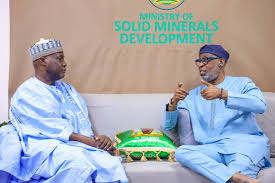
Speaking at the signing ceremony, the Minister of Solid Minerals Development, Dele Alake, said the partnership demonstrates growing international confidence in Nigeria’s mining reforms.
According to him, the Federal Government has been implementing regulatory improvements, tightening licensing processes, and strengthening monitoring mechanisms to ensure transparency and accountability in the sector. He noted that the refinery project aligns with the administration’s broader economic diversification agenda, which prioritises non-oil revenue generation and industrial development.
The Solid Minerals Development Fund, which is playing a central role in facilitating the transaction, described the agreement as a transformative milestone. Its leadership emphasized that the collaboration with AFC would not only bring financing but also technical expertise and project development support.
AFC, a pan-African multilateral development finance institution, has a track record of funding large-scale infrastructure and industrial projects across the continent. Its involvement is expected to provide credibility and financial structure to the refinery initiative.
Economic projections tied to the project are significant. Estimates indicate that the refinery could operate for approximately two decades at high utilisation levels, potentially producing millions of tonnes of alumina over its lifespan.
Analysts suggest that the project could contribute substantially to Nigeria’s Gross Domestic Product while generating billions of dollars in export revenues. In addition, thousands of direct and indirect jobs are expected to be created during both the construction and operational phases, providing a boost to local communities and supply chains.
The refinery investment also has implications for Nigeria’s foreign exchange position. By processing bauxite domestically and exporting higher-value alumina rather than raw materials, the country stands to improve its trade balance. This strategy aligns with global best practices in resource-rich economies, where value addition within the domestic economy leads to stronger industrial linkages and broader economic impact.
Market observers say successful execution will depend on consistent policy support, infrastructure readiness, and effective stakeholder coordination. Reliable power supply, transport logistics, and regulatory clarity will be critical to ensuring that the project meets its projected timelines and output targets.
Nonetheless, the signing of the $1.3 billion deal signals renewed momentum in Nigeria’s mining sector and reinforces the government’s commitment to transforming solid minerals into a key pillar of national economic growth.
As Nigeria continues to pursue economic diversification and industrial expansion, the partnership between the Federal Government and AFC represents a bold step toward unlocking the full potential of the country’s mineral wealth and building a more resilient, export-oriented economy.










Comments