
Real Estate vs Stock Market investing
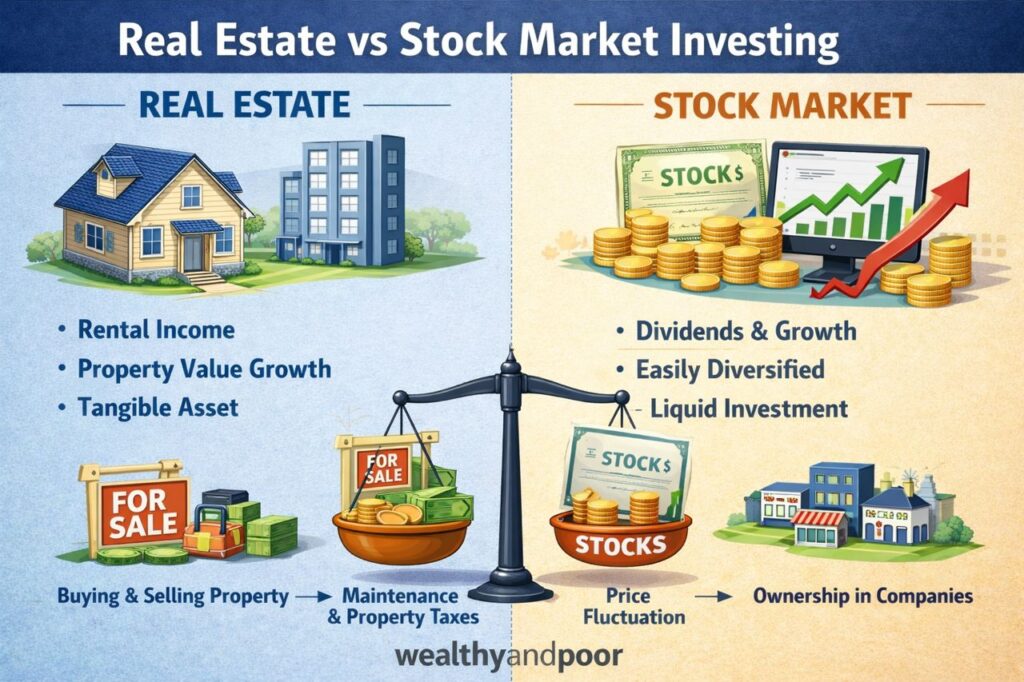

In the world of wealth creation, few debates are as enduring as real estate versus stock market investing. Both asset classes have produced millionaires, weathered economic storms, and evolved with changing financial systems. Yet, they operate on fundamentally different principles, offering distinct advantages and risks. For investors especially in emerging markets like Nigeria the decision is rarely about which is universally “better,” but which aligns best with personal goals, capital, and risk tolerance.
Understanding the Two Asset Classes
At its core, real estate investing involves purchasing physical property residential, commercial, or land with the aim of generating income (rent) or capital appreciation. Stocks, on the other hand, represent ownership in companies, where investors earn returns through price appreciation and dividends.
This structural difference shapes everything from liquidity to risk exposure. Real estate is tangible and often localized, while stocks are intangible and globally influenced.
Entry Barrier and Accessibility
One of the most striking differences lies in accessibility.
Stock market investing has a low barrier to entry. With digital trading platforms, investors can start with minimal capital, even buying fractional shares. This democratization of investing has made stocks especially appealing to younger and first-time investors.
Real estate, by contrast, typically requires significant upfront capital down payments, legal fees, and maintenance costs. For many, this makes property investment a long-term goal rather than an immediate opportunity.
However, this higher barrier can also serve as a filter, often attracting more deliberate, long-term investors.
Returns: Growth vs Income Stability
- Stocks are historically known for strong long-term growth potential, driven by corporate earnings, innovation, and economic expansion. Over time, diversified stock portfolios have delivered competitive returns, especially when reinvesting dividends.
- Real estate offers a different value proposition: dual income streams. Investors can earn rental income while also benefiting from property appreciation. In many cases, especially when leverage (mortgage financing) is used, returns can be amplified significantly.
Moreover, real estate often performs well during inflationary periods, as property values and rents tend to rise alongside prices.
Risk and Volatility
Risk manifests differently across both asset classes.
- Stocks are more volatile, with prices fluctuating daily based on market sentiment, economic data, and geopolitical events. This volatility can create opportunities but also sharp losses in short periods.
- Real estate, on the other hand, is generally less volatile. Property prices tend to move more slowly, offering a sense of stability. However, this does not mean it is risk-free. Market downturns, poor location choices, or tenant issues can significantly impact returns.
Another key distinction: while a stock can theoretically fall to zero if a company fails, real estate typically retains some intrinsic value as a physical asset.
Liquidity and Flexibility
Liquidity is where stocks clearly dominate.
- Stocks can be bought and sold almost instantly, allowing investors to respond quickly to market changes or access cash when needed.
- Real estate is inherently illiquid. Selling property can take months, involving negotiations, legal processes, and transaction costs. This makes real estate less suitable for investors who may need quick access to funds.
Control and Management
- Real estate offers a level of control that stocks cannot match. Investors can directly influence property value through renovations, tenant selection, and rental pricing. This hands-on approach can enhance returns but requires time, expertise, and effort.
- Stocks, by contrast, are largely passive investments. Once purchased, performance depends on company management and market conditions. While this reduces effort, it also limits control.
Diversification and Portfolio Strategy
Diversification is easier and cheaper with stocks. Investors can spread capital across industries, countries, and asset types with minimal cost.
Real estate diversification is more challenging due to high capital requirements. Owning multiple properties across different locations demands substantial financial resources.
That said, modern instruments like Real Estate Investment Trusts (REITs) blur this line, allowing investors to gain real estate exposure through stock-like vehicles.
Costs and Ongoing Expenses
Transaction and maintenance costs further differentiate the two.
- Real estate involves high transaction costs legal fees, agent commissions, taxes and ongoing expenses such as repairs, insurance, and property management.
- Stocks generally have lower costs, especially with commission-free trading platforms. Aside from occasional fees or taxes, ongoing expenses are minimal.
Which Investment Is Better?
The truth is, there is no universal winner.
Choose real estate if you:
- Have substantial capital
- Prefer stable, long-term income
- Are willing to be hands-on
- Want an inflation hedge
Choose stocks if you:
- Have limited starting capital
- Value liquidity and flexibility
- Prefer passive investing
- Seek high growth potential
Increasingly, financial experts argue that the smartest approach is not choosing one over the other but combining both. A balanced portfolio can leverage the stability of real estate and the growth potential of stocks, reducing overall risk.
Conclusion
Real estate and stock market investing are not rivals they are complementary tools in a sophisticated investor’s arsenal. Each serves a different purpose: one builds tangible, income-generating assets; the other offers scalable, liquid growth opportunities.
For investors navigating today’s uncertain economic landscape, the question is not “real estate or stocks?” but rather, “how much of each?”












Comments