
How to Start Investing in Nigeria with Little Money for Beginners


In a country where inflation continues to erode purchasing power and income growth often struggles to keep pace, investing is no longer a luxury it is a necessity. Yet, a common misconception persists among many Nigerians: that investing requires substantial capital. The reality is far more encouraging. Today, with as little as ₦1,000 to ₦10,000, beginners can begin building a solid financial future.
This article breaks down, in practical terms, how to start investing in Nigeria with limited funds without falling into common traps or taking unnecessary risks.
Understanding What Investing Really Means
At its core, investing is about putting your money into assets that can grow over time or generate income. Unlike saving which simply preserves money investing allows your money to work for you.
For beginners, the goal is not to “get rich quickly,” but to build wealth gradually through consistency, discipline, and informed decision-making. As financial experts often emphasize, starting small is not a disadvantage it is an opportunity to learn and grow without exposing yourself to major losses.
How to Stay Rich in Nigeria
Start with the Right Financial Foundation
Before investing, it is critical to put a few basics in place:
- Build a Savings Buffer
You cannot invest effectively without some level of financial stability. Setting aside even 10–20% of your income monthly creates the pool from which investments can grow.
- Define Clear Goals
Ask yourself:
- Are you investing for short-term needs (1–3 years)?
- Medium-term goals (3–7 years)?
- Long-term wealth (7+ years)?
Clarity helps you choose the right investment type and avoid unnecessary risks.
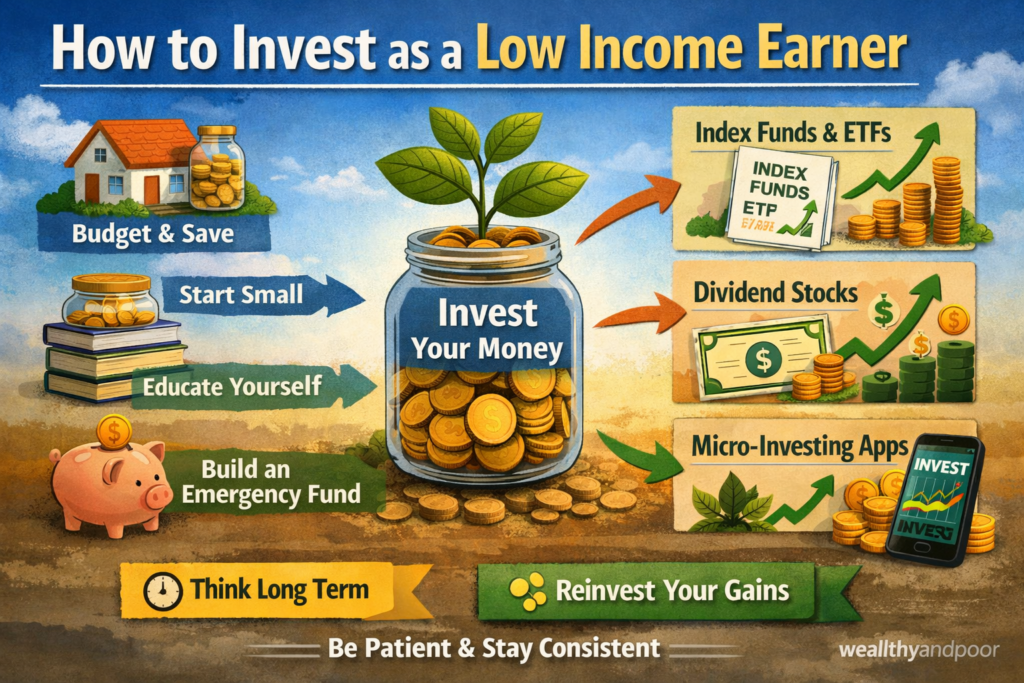
- Start Small, but Stay Consistent
Many Nigerians assume they need millions to begin. In reality, consistent contributions even ₦5,000 monthly can compound into significant wealth over time.
Beginner-Friendly Investment Options in Nigeria
For those starting with little money, accessibility and risk level matter more than complexity. Here are some of the most practical options:
- Micro-Investment and Savings Platforms
Fintech platforms have democratized investing in Nigeria. Apps like Piggy vest, Cowrywise, and others allow users to start with very small amounts and invest in diversified funds.
These platforms often offer:
- Money market funds
- Fixed-income investments
- Automated savings plans
Many allow entry with as little as ₦100 and provide returns higher than traditional savings accounts.
- Treasury Bills and Government Bonds
If safety is your top priority, government-backed securities are a strong starting point.
Treasury bills offer:
- Low risk
- Predictable returns
- Flexible tenures
They are ideal for beginners who want steady growth without volatility.
- Mutual Funds
Mutual funds pool money from multiple investors and are managed by professionals. This makes them perfect for beginners who lack deep market knowledge.
Types include:
- Money market funds (low risk)
- Fixed-income funds (moderate stability)
- Equity funds (higher risk, higher return potential)
With as little as ₦5,000, beginners can access diversified portfolios.
- Skill Investment (Often Overlooked)
One of the most powerful investments is in your own earning ability.
Learning skills like:
- Copywriting
- Graphic design
- Digital marketing
can generate income that can later be reinvested. In many cases, this delivers higher returns than traditional investments, especially at the early stage.
- Small-Scale Business and Side Hustles
Investing does not always mean financial markets. Starting a small business such as airtime resale, mini-importation, or digital product sales can be a highly effective way to grow capital.
With ₦2,000–₦10,000, many Nigerians are already building scalable income streams from their smartphones.
Smart Strategies Every Beginner Should Follow
Starting is important but starting wisely is what truly matters.
- Diversify Your Investments
Even with small capital, avoid putting all your money in one place. Spread across:
- Savings platforms
- Fixed-income products
- Small business ventures
- This reduces risk and improves stability.
- Focus on Consistency Over Size
A key principle of investing is that regular contributions matter more than large one-time deposits. Automated savings and investment tools can help enforce discipline.
- Avoid “Get-Rich-Quick” Schemes
Ponzi schemes and unrealistic investment promises remain widespread. If an opportunity guarantees unusually high returns with little risk, it is likely fraudulent.
Always verify:
- Regulatory approval (SEC, CBN)
- Company track record
- Transparency of operations
- Reinvest Your Returns
Rather than spending profits early, reinvest them. This is how compounding works your money begins to generate more money over time.
Common Mistakes to Avoid
Even with the best intentions, beginners often make costly errors:
- Investing without research
- Following trends blindly (e.g., crypto hype)
- Withdrawing too early due to impatience
- Ignoring inflation
Avoiding these mistakes can be just as important as choosing the right investment.
Conclusion
Starting your investment journey in Nigeria with little money is not only possible it is increasingly practical in today’s digital economy. The real barrier is no longer capital, but knowledge and consistency.
You do not need to wait until you earn more. You need to start with what you have, stay disciplined, and grow steadily.
In the end, wealth is rarely built overnight. It is built quietly through small, consistent decisions repeated over time.










Comments