
Why your account cannot receive money
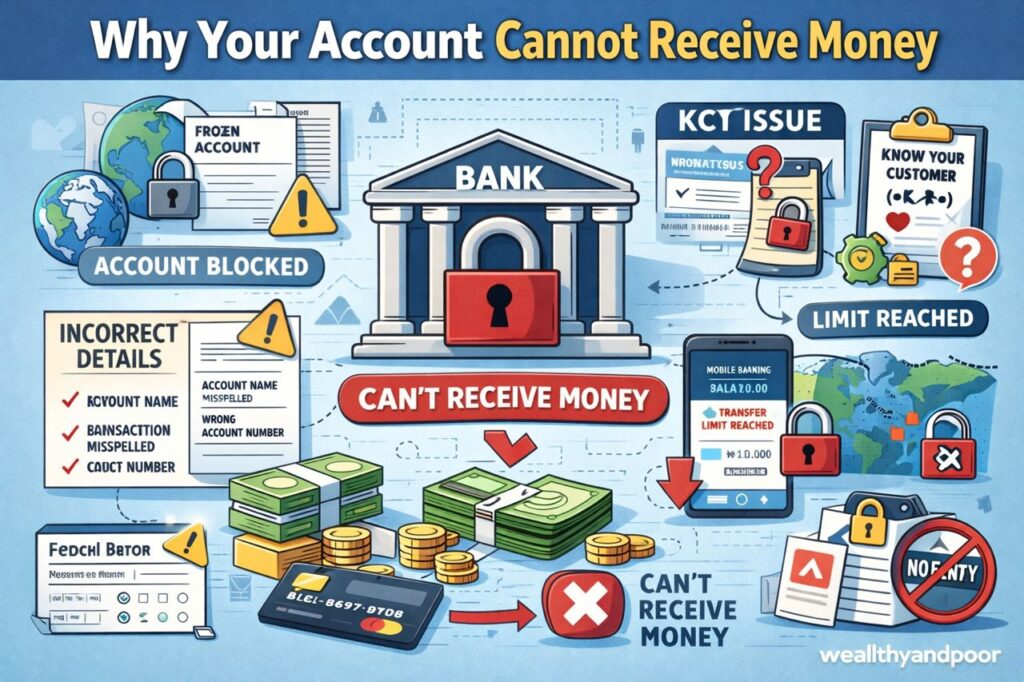

In Nigeria’s increasingly digital financial system, receiving money should be instant and seamless. Yet, many individuals and businesses still face a frustrating reality: funds are sent, but their accounts cannot receive them. This issue cuts across commercial banks, fintech platforms, and mobile money services and often leaves users confused about what went wrong.
Understanding why your account cannot receive money is critical, not just for resolving immediate issues, but also for maintaining smooth financial operations in an economy that is rapidly going cashless.
- Account Restrictions and Compliance Issues
One of the most common reasons your account cannot receive money is restriction placed by your bank. Financial institutions in Nigeria operate under strict regulatory guidelines from the Central Bank of Nigeria (CBN), particularly around identity verification and fraud prevention.
If your account has issues such as:
- Incomplete Know Your Customer (KYC) details
- Unverified or mismatched Bank Verification Number (BVN)
- Suspicious transaction patterns
the bank may partially or fully restrict it.
BVN-related problems are especially common. Since BVN links all your bank accounts into a single identity system, any inconsistency can trigger restrictions that prevent incoming transfers.
- Dormant or Inactive Account Status
An account that has not been used for a long period may become dormant. Dormant accounts are typically restricted from receiving funds until reactivated.
Banks classify accounts as dormant after months or years of inactivity. When this happens:
- Transfers may fail automatically
- Incoming funds may be rejected
- Additional verification may be required
According to financial service providers, sending money to an inactive or closed account is a common reason funds are not received.
- Wrong Account Details
Sometimes, the issue is not with your account but with the sender.
Even a small error in:
- Account number
- Bank name
- Beneficiary selection
can prevent a successful transfer. In some cases, the money may go to the wrong account entirely or remain pending until reversed. This is why banks emphasize confirming recipient details before completing transactions.
- Network Failures and System Downtime
Nigeria’s banking infrastructure relies heavily on interconnected systems such as the Nigeria Inter-Bank Settlement System (NIBSS). While designed for instant transfers, these systems are not immune to failure.
Common technical causes include:
- Network downtime
- Bank server maintenance
- System upgrades
When these occur, transfers may be delayed or fail entirely, even if the sender’s account is debited.
High transaction volumes especially during salary periods, weekends, or festive seasons can also overload systems and disrupt transfers.
- Transaction Limits and Tier Restrictions
Not all accounts are equal. Many Nigerian bank accounts operate under tiered limits based on verification level.
For example:
- Tier 1 accounts (minimal documentation) have strict limits
- Tier 2 and Tier 3 accounts allow higher inflows
If a transfer exceeds your account’s allowed limit, it may be rejected automatically. Additionally, some accounts have daily or cumulative caps on incoming funds.
Banks may also block transactions if compliance thresholds are exceeded, particularly for large or unusual transfers.
- Legal or Security Holds
In some cases, accounts are flagged for legal or security reasons. This can happen due to:
- Suspected fraud
- Money laundering concerns
- Court orders or debt recovery actions
When this occurs, the account may be frozen or restricted. While deposits may still enter in some cases, access to funds and sometimes incoming transfers can be limited until the issue is resolved.
- Pending or Processing Transactions
Sometimes your account can receive money but the transaction is still “in progress.”
A pending transfer means:
- The sender’s bank has initiated the transaction
- The receiving bank has not completed processing
This delay can occur due to technical, operational, or settlement issues between banks.
In most cases, the money is not lost and will either:
- Be credited after some time, or
Be reversed back to the sender
- Account Type Limitations
Certain accounts are not designed to receive all types of payments. For example:
- Some savings accounts may restrict business inflows
- Wallets or fintech accounts may have limited receiving capabilities
- Foreign transfers may require special activation
If your account is not configured for a specific transaction type, the transfer may fail.
- Interbank Settlement Delays
Behind every transfer is a settlement process between banks. If there are delays in clearing or liquidity issues between financial institutions, funds may not reflect immediately.
This is particularly common during:
- Late-night transactions
- End-of-day processing
- Cross-bank transfers
Such delays can create the impression that your account cannot receive money when, in reality, the process is still ongoing.
What You Should Do If Your Account Cannot Receive Money
If you encounter this issue, take the following steps:
- Verify your account details
- Check your account status (active, restricted, or dormant)
- Confirm your BVN and KYC compliance
- Review transaction limits on your account
- Wait briefly for possible network delays
- Contact your bank with transaction proof
Most transfer issues in Nigeria are temporary and can be resolved once the root cause is identified.
Conclusion
The inability of a bank account to receive money is rarely random. It is usually the result of regulatory controls, technical issues, or simple human error. As Nigeria continues its shift toward a fully digital financial system, these challenges are becoming more visible but also more manageable with the right knowledge.
For individuals and businesses alike, staying informed about how the banking system works is no longer optional. It is essential.










Comments