
Why Virtual Cards Stop Working Suddenly
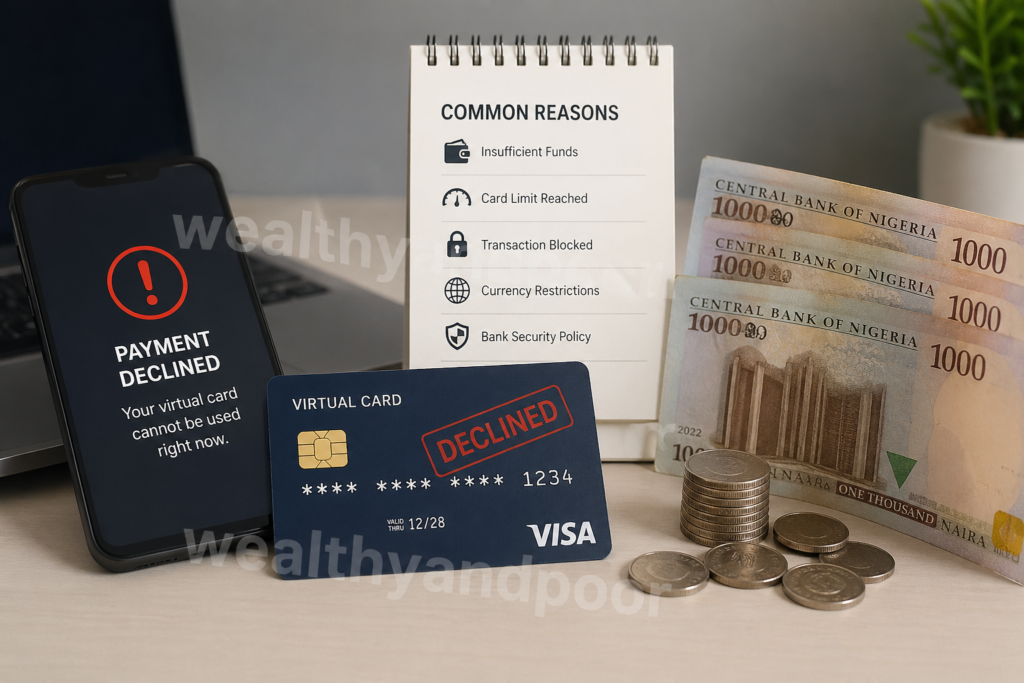

Virtual cards have become a lifeline for online payments especially in countries like Nigeria where users rely on them for subscriptions, international purchases, and digital services. But one of the most frustrating experiences is when a virtual card that worked yesterday suddenly stops working today with no clear warning.
This isn’t random. Virtual card failures are usually the result of underlying systems, rules, and safeguards quietly working in the background. Understanding these hidden triggers can help users avoid repeated declines and financial disruption.
The Illusion of “Sudden” Failure
When a virtual card stops working, it often feels abrupt. In reality, most failures are the final outcome of conditions that have been building over time balance issues, risk signals, or platform restrictions.
As highlighted by Wealthy and Poor, virtual card declines are rarely accidental; they are typically tied to technical limitations, security controls, or merchant-specific rules.
- Insufficient Balance Still the #1 Cause
The most common and often overlooked reason is simple: the card itself doesn’t have enough money.
Unlike traditional debit cards linked directly to your bank account, most virtual cards are pre-funded. This means:
- The card must hold the exact amount needed
- Extra charges (like foreign exchange fees or taxes) can cause unexpected declines
Even if your main wallet has money, the transaction will fail if the virtual card balance is insufficient.
- Silent Security Blocks
Virtual cards are heavily protected by fraud detection systems. If something looks unusual, your card may be automatically frozen or restricted without notice.
Common triggers include:
- Unusual transaction patterns
- Logging in from a new device or location
- Repeated failed payment attempts
In such cases, the card may appear active in your app but won’t process payments.
- Merchant Restrictions and Compatibility Issues
Not all online platforms accept virtual cards even if they carry global brands like Visa or Mastercard.
Some merchants:
- Block prepaid or virtual cards entirely
- Require physical debit/credit cards
- Reject cards from certain countries
Additionally, some payment processors (like Stripe or PayPal) may decline transactions based on risk scoring or regional policies.
- Subscription and Recurring Payment Failures
Virtual cards often fail during auto-renewals, and this is where many users get caught off guard.
Why it happens:
- The card expired or was regenerated
- Balance was insufficient at renewal time
- Merchant retry logic failed after previous declines
Once a subscription fails, some platforms stop retrying entirely, making it seem like the card “just stopped working.”
- Card Expiry, Deactivation, or Limits
Virtual cards are not always permanent. Many are designed with built-in restrictions such as:
- Expiry dates
- Single-use functionality
- Daily or monthly spending limits
Once any of these limits are reached, transactions will fail automatically.
- Network, System, or Provider Downtime
Sometimes, the issue has nothing to do with the user.
Virtual cards depend on:
- Fintech apps
- Payment gateways
- Banking infrastructure
If any of these systems experience downtime or maintenance, transactions may fail temporarily.
In Nigeria, this is particularly common when fintech platforms:
- Upgrade systems
Pause services due to regulatory or exchange rate issues
- Currency and International Payment Barriers
A major issue for Nigerian users is currency mismatch.
For example:
- Using a naira card on a dollar-based platform
- Exchange rate fluctuations affecting transaction approval
- International merchants blocking non-local cards
These factors can cause declines even when everything appears correct on your end.
- Risk Scoring and “Invisible Judgement”
Behind every virtual card transaction is a complex risk engine.
Payment systems evaluate:
- Card origin (BIN)
- Transaction behavior
- Device and IP consistency
- Account history
If your transaction is flagged as risky even incorrectly it may be declined instantly.
This explains why:
- One payment works
The next one fails on the same platform
- Incorrect Details or Verification Failures
Sometimes the issue is basic but easy to miss:
- Wrong CVV or expiry date
- Billing address mismatch
- Failed OTP (3D Secure authentication)
Even a small mismatch can cause a transaction to be rejected instantly.
- Regulatory and Market Factors
In markets like Nigeria, virtual card reliability is also influenced by:
- Central bank policies
- Foreign exchange restrictions
- Third party provider disruptions
Some fintech platforms have even paused virtual card services entirely due to these pressures.
Conclusion: It’s Rarely Random
When a virtual card stops working suddenly, it’s rarely a mystery it’s usually a system responding to risk, rules, or limitations.
The key takeaway is this:
Virtual cards operate in a stricter, more controlled environment than traditional bank cards. Every transaction passes through multiple checks, and any small issue funding, security, compatibility, or regulation can trigger a decline.
For users, the best defense is awareness:
Always fund the card adequately
Monitor subscription renewals
Understand platform restrictions
Keep your app and details updated
In a digital financial system built on automation and risk control, “sudden failure” is often just the visible result of invisible processes working exactly as designed.












Comments