
Hidden Bank Charges You Might Not Know
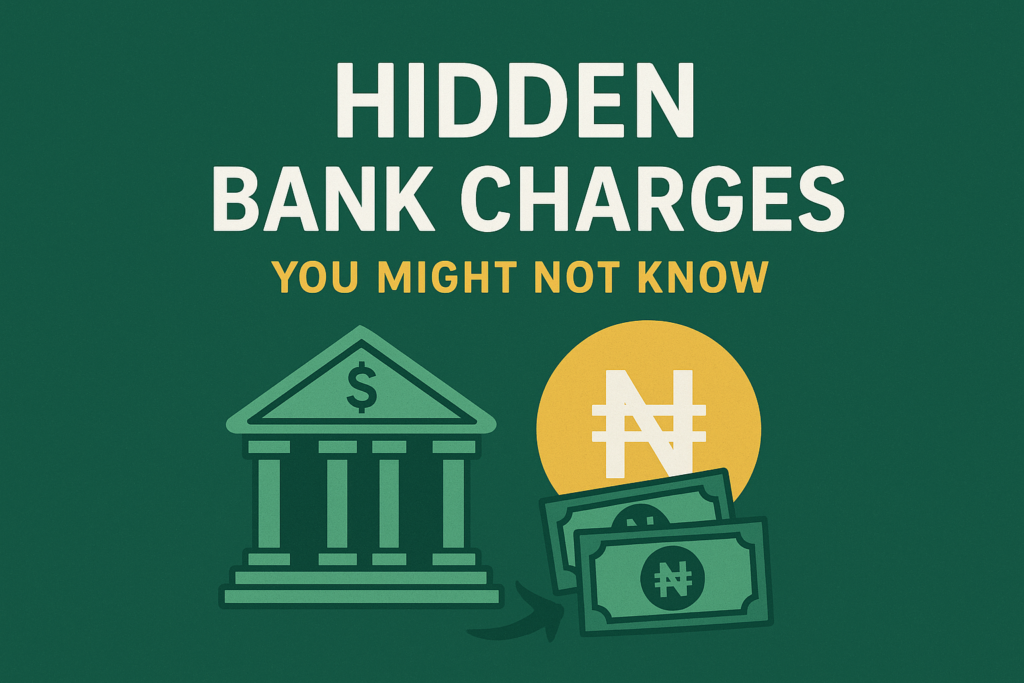

For many Nigerians, checking a bank statement often raises more questions than answers. Beyond the obvious charges for transfers or withdrawals, there are usually several small deductions that appear unexpectedly — amounts like ₦11.25, ₦50, ₦65, or other irregular figures with vague descriptions.
While each charge may seem insignificant on its own, over time they accumulate into substantial losses, especially for individuals, students, small business owners, and salary earners who rely heavily on digital banking.
These deductions are commonly referred to as hidden bank charges, not because banks operate illegally, but because most customers are either unaware of them or do not fully understand why they exist.
Some of these charges are statutory deductions mandated by government regulations, such as stamp duty and Value Added Tax (VAT). Others are service-related fees introduced by banks for convenience-based offerings like SMS alerts, ATM usage, card maintenance, or electronic transaction processing.
In recent years, as Nigeria continues its transition toward a cashless economy, the frequency of electronic transactions has increased significantly. Transfers, card payments, ATM withdrawals, USSD banking, and online purchases now form part of everyday financial activities.
While these innovations improve convenience, they also introduce multiple layers of transaction costs that are often buried within banking systems and statements. Without proper awareness, customers may unknowingly pay for services they do not need or could easily avoid.
₦50 transfer / electronic receipt levy (stamp duty / EMTL)
Many customers see a ₦50 deduction on transfers or deposits (usually on receipts ≥ ₦1,000 or on electronic receipts ≥ ₦10,000 depending on the regulation cited). This charge stems from stamp duty rules and more recently from the Electronic Money Transfer Levy (EMTL) regulations and CBN instructions that require an N50 levy on certain electronic receipts. It’s not the bank “stealing” — it’s a statutory levy collected at source and remitted under regulation.
What to know: The levy applies per qualifying receipt/transfer and is not a percentage — so frequent small receipts mean many N50 debits.
Read Also : Why Nigerian Banks Deduct ₦50 Naira From Transfers
VAT on bank services
Banks charge value-added tax (VAT) on many services (e.g., SMS alert subscription fees, account maintenance where applicable, card-related service fees). The Federal Inland Revenue Service (FIRS) has clarified that many financial services are VAT related and banks add VAT to the underlying fee — the VAT line can look like a tiny recurring charge (e.g., ₦11.25 on a ₦75 service).
What to know: VAT is calculated on the taxable service amount; if the base fee changes, the VAT amount changes too.
SMS alert and USSD charges
SMS alert fees used to be charged monthly by many banks; some customers still see bundled SMS deductions or per-alert fees. Banks have also introduced USSD session fees (some deducted from airtime balance when CBN or banks adopt that model). These micro-charges appear frequently and add up over time. Many banks now allow customers to receive app push notifications or email alerts as free alternatives.
Read Also: SMS Alert charges in Nigeria | How to stop them
ATM withdrawal and “on-other-bank” fees
Cash withdrawals on another bank’s ATM (“not on-us”) typically attract a fee that varies by bank and withdrawal band. CBN pricing guidance and individual bank pricing guides show this clearly (examples in banks’ published tariff documents). Using your own bank’s ATM or getting cashless transfers where possible reduces these charges.

Card maintenance / annual fees
Some banks charge monthly or quarterly card maintenance fees (recently many migrated to a ₦50 quarterly fee for basic naira debit cards) or annual fees for premium cards. Banks publish these in tariff guides; changes often follow CBN guidance. For infrequent card users, these small periodic fees erode balances over time.
“Hidden” service charges and commissions
Banks may apply charges labeled as “e-business fees”, “service charges”, or “commission on collection” — these appear on statements under various descriptions. While many are legitimate, the onus is on customers to read tariff guides and ask for explanations for unfamiliar descriptions.
Why regulators allow these fees (and what’s changing)
Charges are often either statutory (stamp duty, EMTL) or allowed under CBN guides to compensate banks for service delivery and to support policy goals (e.g., encouraging cashless transactions). Recent CBN circulars and policy shifts continue to influence fee structures (e.g., revisions to card maintenance and cash-management policies), so expect periodic updates from both CBN and FIRS that affect what appears on your statement.
How to spot and reduce these charges
- Banks publish a pricing or tariff guide (PDF) on their website — check it for exact amounts (SMS, ATM, card maintenance, USSD, etc.) and how frequently they’re charged. Use that as your reference when challenging unexpected debits.
- Switch notifications from SMS to app/email : If you’re being charged for SMS alerts, switch to the bank’s mobile app push notifications or email statements where possible — many banks allow you to opt out of SMS for a lower cost or zero cost. Some fintech and digital banks offer free push notifications by default.
- Batch transfers and receipts where possible: Because some levies are per receipt (e.g., N50 stamp duty/EMTL), batching incoming transfers or making fewer, larger receipts can reduce how often the levy applies. For businesses, centralized collection accounts can minimize duplicate levies.
- Use your bank’s own ATM or go cashless : Use your bank’s ATMs for cash withdrawals to avoid “not on-us” charges. When sending money, prefer bank app transfers (which may have lower fees) over repeated teller deposits.
- Ask for fee waivers or product switches: If you rarely use a debit card, ask your bank to move you to a no-maintenance account (if they offer one) or request a waiver. Students, seniors, and staff accounts sometimes have preferential (lower or zero) maintenance fees.
- Keep business receipts and dispute errors: If a bank debits a fee that doesn’t match its published tariff or seems duplicated, raise a formal complaint and include screenshots of the tariff page or regulatory circular.

In Conclusion: Hidden bank charges aren’t mysterious when you know where they come from: some are tax-like levies (stamp duty/EMTL), some are VAT or regulatory, and some are bank service fees. Knowing the rules, using the bank’s published pricing guide, and switching to cost-effective alternatives will keep more naira in your pocket.











Comments