
Alternative Proof of Address in Nigeria
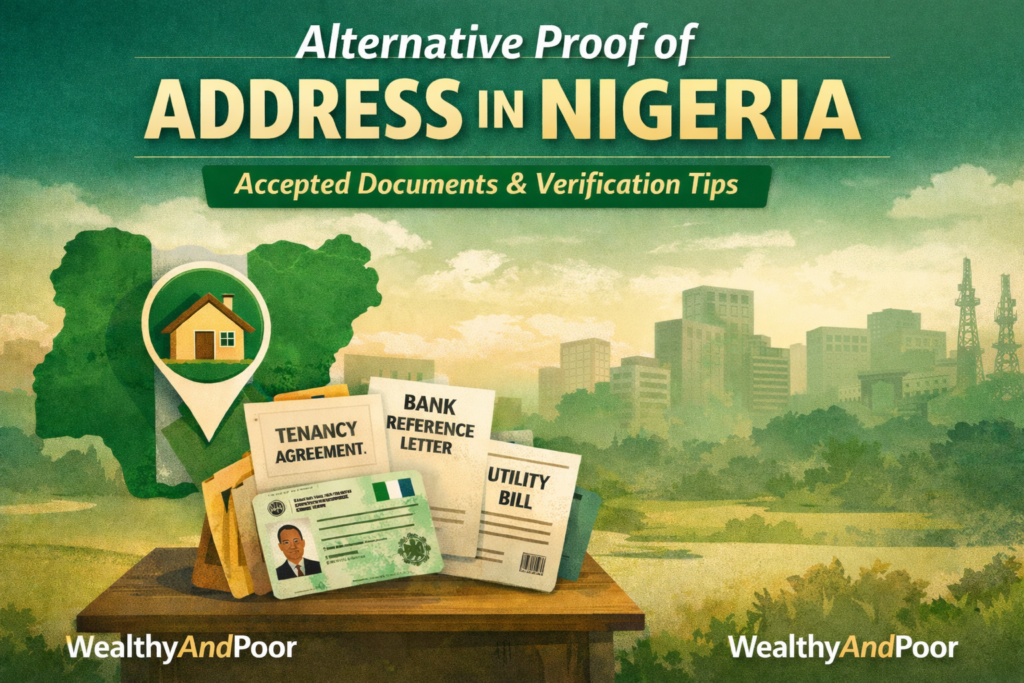

Proof of address remains one of the most common requirements in Nigeria’s banking and financial system. From opening a new bank account to upgrading to a Tier 3 account, completing KYC on fintech apps, or accessing higher transaction limits, Nigerians are often asked to submit a valid proof of address.
However, many people do not have utility bills in their names. This has made alternative proof of address in Nigeria a critical topic for students, renters, NYSC members, freelancers, and young professionals.
This comprehensive guide explains what alternative proof of address means, why it is required, and the accepted alternatives Nigerian banks and fintech platforms recognize today. Proof of address is any official document used by banks and financial institutions to confirm where a customer lives. It usually contains:
- Full name
- Residential address
- Date of issuance
- Issuer’s name or authority
Under Central Bank of Nigeria (CBN) regulations, proof of address is part of Know Your Customer (KYC) requirements designed to prevent fraud, money laundering, and identity theft.
Nigerian banks and fintech companies request proof of address to:
- Verify customer identity beyond BVN and NIN
- Reduce impersonation and account fraud
- Track suspicious financial activities
Comply with CBN and anti-money laundering regulations, Utility bills are considered the standard proof of address, but many Nigerians cannot provide them due to:
- Living in rented apartments where bills are in the landlord’s name
- Staying with parents or relatives
- Residing in student hostels or shared apartments
- Using prepaid meters registered under another person
- Living in informal or rural settlements without formal billing
Because of these realities, Nigerian banks now accept alternative proof of address documents.
What Is Alternative Proof of Address?
Alternative proof of address refers to non-utility documents that can reasonably confirm a person’s place of residence. These documents must still be:
- Recent (usually within 3 months)
- Verifiable
- Issued by a credible institution
- Clearly showing the customer’s name and address
Acceptance may vary slightly between banks, but most follow similar standards.
Accepted Alternative Proof of Address in Nigeria
1. Bank Reference or Address Confirmation Letter
A bank reference letter is one of the most widely accepted alternatives across Nigerian banks.
This letter:
- Is issued by a bank on official letterhead
- Confirms the customer’s residential address
- Is signed and stamped
Many banks accept this for Tier 3 account upgrades and inter-bank verification.
2. Rent Receipt
Tenancy agreements are commonly accepted, especially for renters.
For approval:
- The address must be clearly stated
- The customer’s name must appear as the tenant
- The agreement should be current or recently signed
Some banks may request additional verification if the document is informal.
3. Letter of Address Confirmation (Landlord or Employer): An address confirmation letter from a landlord, employer, or institution can serve as valid proof.
Such letters should:
- Be addressed to the bank
- Include the full residential address
- Be signed and dated
- Be accompanied by the issuer’s valid ID
This option is popular among students, NYSC members, and staff accommodation residents.
3. Government-Issued Documents with Address
Certain government documents showing your address are accepted by many banks, including:
- Driver’s licence
- National Identity Number (NIN) slip or card (if address is stated
- Permanent Voter’s Card (PVC), depending on the bank
Because these documents are government-issued, they carry higher credibility.
4. Recent Bank Statement Showing Address: Some banks accept stamped bank statements that display the customer’s address.
Conditions usually include:
- Statement must be recent (within 3 months)
- Address must be visible
- Statement may need to be stamped or certified
This is more common for account upgrades and fintech verification.
5. Utility Bill in a Relative’s Name (With Affidavit): In some cases, banks accept utility bills not in the customer’s name, provided additional documents are submitted, such as:
- Sworn affidavit of residence
- Relationship confirmation letter
- Valid ID of the bill owner
This option depends on the bank’s internal compliance policy
How Proof of Address Affects Bank Account Tiers
Proof of address is especially important when upgrading accounts.
- Tier 1 accounts – Usually no proof of address required
- Tier 2 accounts – Limited address verification
- Tier 3 accounts – Proof of address is mandatory
Without acceptable proof, customers cannot enjoy higher daily transaction limits.
Fintech Platforms and Address Verification in Nigeria
Many fintech companies now use digital KYC systems linked to BVN and NIN databases. While this has reduced friction, full access and higher limits still require address verification.
As fintech adoption grows, alternative proof of address remains essential.
Read Also:
Conclusion
Alternative proof of address in Nigeria has become a practical solution to real-life housing and living arrangements. While utility bills remain the standard, Nigerian banks and fintech platforms now recognize several credible alternatives.
Understanding these options helps individuals upgrade accounts faster, avoid unnecessary delays, and access full financial services. Whether you are a student, renter, freelancer, or young professional, having the right documentation makes a significant difference.
As Nigeria’s financial system continues to expand and digitize, flexible address verification will remain a key driver of financial inclusion.











Comments