
Beginner Mistakes When Buying Bank Stocks
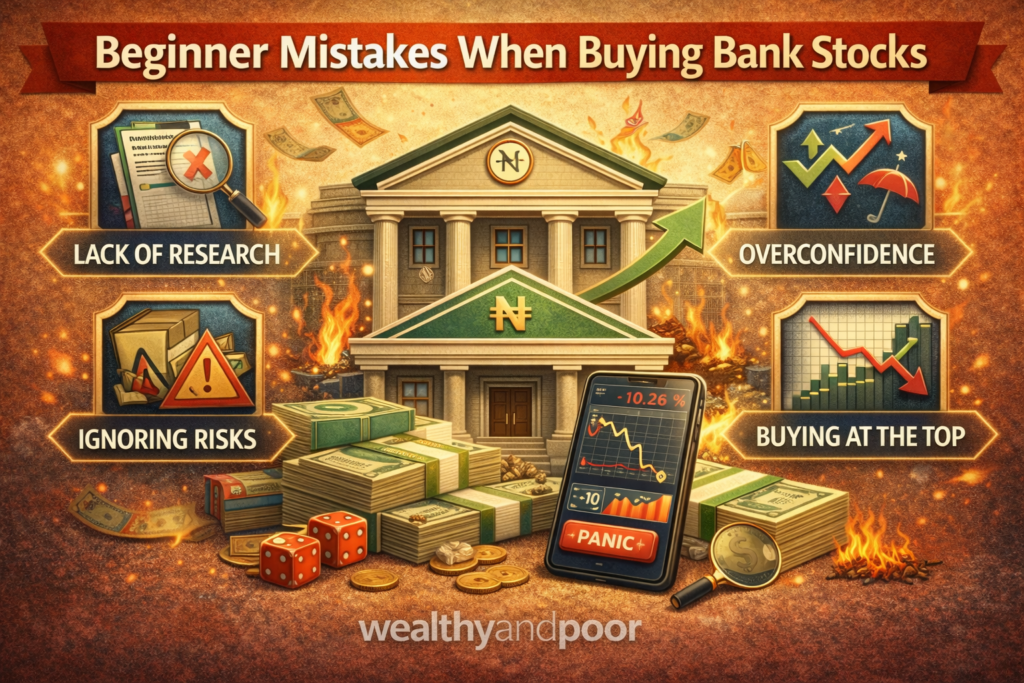

Investing in bank stocks can be a solid way to build wealth, especially in Nigeria where the financial sector remains one of the most traded on the Nigerian Stock Exchange (NGX). Banks like Zenith Bank, Guaranty Trust Bank (GTBank), and Access Holdings are household names among investors. However, many beginners make costly mistakes that erode returns and increase risk unnecessarily.
This article explains common beginner mistakes, why they matter, and how to avoid them. The goal is to give you a strong foundation so you make smarter, more confident investment choices in bank stocks.
Failing to Understand the Banking Business Model
Why It Matters
Unlike consumer goods companies, banks make money primarily through interest spreads the difference between the interest they charge borrowers and what they pay depositors. They also earn from fees, forex trading, and investments.
If you don’t understand how banks earn profits, you may misread their performance.
Example
A bank could show higher profit but with rising non-performing loans (NPLs), indicating trouble collecting debts.
How to Avoid This Mistake
Before investing:
- Read bank financial reports.
Learn key metrics such as Net Interest Margin (NIM), Return on Equity (ROE), and Cost-to-Income Ratio.
Not Researching Fundamentals Before Buying
What Are Fundamentals?
Fundamental analysis involves evaluating:
- Earnings per share (EPS)
- Price-to-Earnings (P/E) Ratio
- Dividend history
- Asset quality
- Capital adequacy
Beginners often buy bank stocks because they are popular, not because they are fundamentally strong. Buying a bank stock solely because:
- It’s trending on social media
- A friend recommended it
- It has a cheap price tag
- Price alone doesn’t tell you if the stock is a good value.
How to Avoid This Mistake
Use fundamental ratios to assess value. For example:
- A bank with a very high P/E compared to peers may be overpriced.
- A bank with declining ROE could signal weakening profitability.(NGX Market Data)
Ignoring Macro-Economic Conditions
Why Banking Stocks Are Sensitive
Banks are especially influenced by:
- Interest rate changes
- Inflation levels
- Currency stability
- Economic growth
In Nigeria, these macro factors can shift quickly due to policy changes or global economic events.
For example, rising interest rates may benefit banks by increasing yields but could also increase defaults if borrowers can’t repay loans.
How to Avoid This Mistake
- Monitor Central Bank of Nigeria (CBN) policies.
- Track inflation and interest rate data.
Neglecting Risk Management
Beginners Often Overlook:
- Portfolio diversification
- Risk tolerance
- Stop-loss strategies
Investing heavily in one bank stock exposes you to significant risk. For instance, if that bank faces regulatory issues or loan defaults spike, your portfolio suffers deeply.
How to Avoid This Mistake
- Diversify across financials and other sectors.
- Only allocate a percentage of your total portfolio to any single bank stock.
- Use basic risk tools like stop loss orders.
- Learn about risk management:
Chasing Past Performance : The Trap
Beginners often buy stocks because they have historically delivered high returns e.g., banks that have done well in the last 3–5 years.
While past performance matters, it is not a guarantee of future results.
Example
Bank A may have paid strong dividends in the past but later struggles due to asset quality issues or higher loan defaults.
How to Avoid This Mistake
- Always pair historical performance with forward-looking analysis, such as:
- Future earnings projections
- Sector outlook
- Economic forecasts
Ignoring Dividend Sustainability
Dividends Are Important
Many Nigerian investors buy bank stocks for dividends. But dividends must be sustainable.
If a bank faces declining profits or regulatory capital pressures, it may cut dividends, which could hurt share prices.
Dividend Red Flags
- Declining payout ratio over time
- Lower retained earnings
- High loan loss provisions
How to Avoid This Mistake
Study dividend history and payout ratios (dividend per share divided by EPS). If dividends are inconsistent, investigate why.
Short-Term Trading Instead of Long-Term Investing
Beginners Often Get Burned Because:
- They try to time the market
- They react emotionally to price swings
- They panic sell during volatility
Bank stocks can be volatile, especially during economic uncertainty.
Why Long-Term Works Better
Long-term investing allows you to ride out volatility, benefit from compound growth, and focus on fundamentals rather than noise.
How to Shift Mindset
- Set clear investment goals
- Adopt a long-term horizon (3 to 10+ years)
- Avoid frequent trading unless you have skill and strategy
Overlooking Regulatory and Governance Risks
What This means:
Banks operate under strict regulations from the CBN and other regulators. Regulatory changes can impact:
- Capital requirements
- Loan classification rules
- Interest rate caps
Governance issues (poor leadership, fraud, insider related transactions) can also decimate shareholder value.
How to Avoid This Mistake
- Read regulatory filings
- Look for strong governance practices
- Be wary of banks with frequent management reshuffles
Using Incomplete or Untrusted Information Sources
Why This Happens
Beginners may rely on:
- WhatsApp or Telegram tips
- Unverified social media posts
- Rumors and hearsay
This leads to poor decision making.
How to Find Reliable Information
- NGX official sources: Bank audited financials on NGX or company websites
- Reputable financial news outlets (Bloomberg, Reuters, Business day Nigeria)
Examples:
Bloomberg Markets
Business day Nigeria
Emotional Investing :The Problem
- Fear and greed drive many bad decisions.
- Greed: Buying at all-time highs
- Fear: Selling on slight pullbacks
How to Avoid Emotional Traps
- Use a written investment plan
- Set entry and exit rules
- Use target prices
- Define acceptable loss levels
Keep emotions aside. Stock markets fluctuate; being disciplined matters more than being right every time.
Conclusion
Investing in Nigerian bank stocks can be rewarding, but beginners often make avoidable mistakes that reduce returns and elevate risk. The key lessons for Nigerian investors are:
Understand how banks make money
Perform thorough fundamental analysis
Account for economic and regulatory environments
Manage risk through diversification and strategy
Avoid emotionally driven decisions
With the right approach, investing in bank stocks can be a cornerstone of your wealth building journey in Nigeria.












Comments