
Can Banks Close Your Account Without Warning?
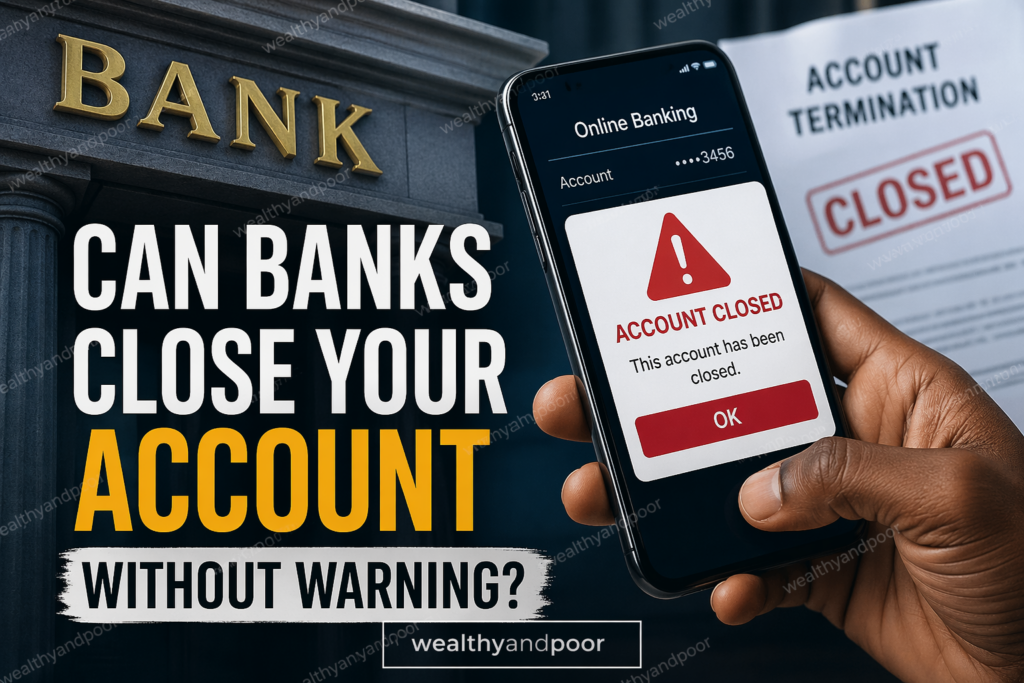

In Nigeria’s evolving financial system, one question continues to surface among bank customers: can a bank suddenly shut down your account without telling you? The short answer is yes but not arbitrarily. Nigerian banking laws, regulatory directives, and court rulings show that while banks have the power to close accounts, that power is guided by strict conditions, contractual obligations, and consumer protection rules.
At its core, the relationship between you and your bank is a contractual agreement. Once you open an account, both parties are bound by the terms and conditions you accepted. Central Bank of Nigeria regulations and Nigerian law shape how far a bank can go and when.
Banks in Nigeria can close accounts without giving advance warning in certain high-risk or regulatory-driven situations. These cases are usually tied to compliance, fraud prevention, or national financial security policies.
One of the most common triggers is failure to meet Know Your Customer (KYC) requirements. For instance, accounts without a valid Bank Verification Number (BVN) were ordered to be shut down within a fixed timeline by the regulator.
This shows that regulatory directives can override the need for prolonged notice.
Similarly, accounts suspected of:
- Fraud or financial crimes
- Money laundering activities
- Terrorism financing links
- Regulatory violations (e.g., banned transactions like certain crypto-related activities in the past)
May be restricted or closed immediately. In fact, a 2025 Court of Appeal position affirmed that banks can act swiftly when suspicious activity is detected, even before lengthy procedures are completed.
In such cases, the bank’s priority is to protect the financial system, not necessarily to give prior notice.
Regulatory Powers and Directives
Banks do not always act on their own. Many closures happen because of direct instructions from regulators.
The Central Bank of Nigeria regularly issues circulars requiring banks to:
- Close non-compliant accounts
- Enforce stricter identity verification
- Restrict accounts linked to suspicious transactions
For example, enforcement of BVN compliance led to millions of accounts being flagged or closed within deadlines.
There have also been instances where accounts were closed over policy violations such as cryptocurrency trading restrictions introduced at certain periods.
When Banks Are Expected to Inform You
While banks can act without warning in high-risk scenarios, not all closures should happen silently.
Under consumer protection principles, customers have the right to be informed about actions affecting their accounts.
This includes:
- Clear communication of account terms
- Notification of major changes
- Access to complaint and redress channels
In normal situations such as account inactivity, policy changes, or administrative reasons banks are expected to notify customers before closure.
Account Closure vs Account Freezing
Know the Difference: It’s important not to confuse account closure with account restriction (freezing).
Account closure: The banking relationship is terminated.
Account freezing (Post-No-Debit): You can’t access funds, but the account still exists.
Legally, freezing an account is more sensitive. Nigerian courts have held that banks generally require a court order to freeze accounts, especially when acting on behalf of law enforcement agencies.
However, in urgent fraud-related cases, banks may temporarily restrict accounts pending further action or investigation.
Your Rights as a Bank Customer
Even though banks have strong regulatory powers, customers are not without protection. Nigerian banking rules guarantee several rights, including:
- Right to information about account status and policies
- Right to fair treatment and non-discrimination
- Right to complaint and redress mechanisms
- Right to close your account voluntarily
These rights are reinforced by consumer protection frameworks designed to ensure transparency and accountability in the financial system.
What to Do If Your Account Is Closed Without Warning
- Contact your bank immediately for clarification
- Request a formal explanation in writing
- Check for regulatory or compliance issues (BVN, KYC, suspicious transactions)
- Escalate to the bank’s complaint unit
If unresolved, report to the Central Bank of Nigeria or seek legal advice
In cases of wrongful closure or restriction, Nigerian courts have awarded damages to affected customers.
In Conclusion: Banks in Nigeria can close your account without warning but only under specific, legally backed circumstances, especially where fraud, regulatory breaches, or national financial policies are involved. Outside of these situations, customers are entitled to transparency, communication, and fair treatment.
For everyday banking users, the safest approach is simple: keep your account compliant, avoid suspicious transactions, and always stay updated with your bank’s policies.











Comments