
Daily Transfer Limits by Nigerian Banks
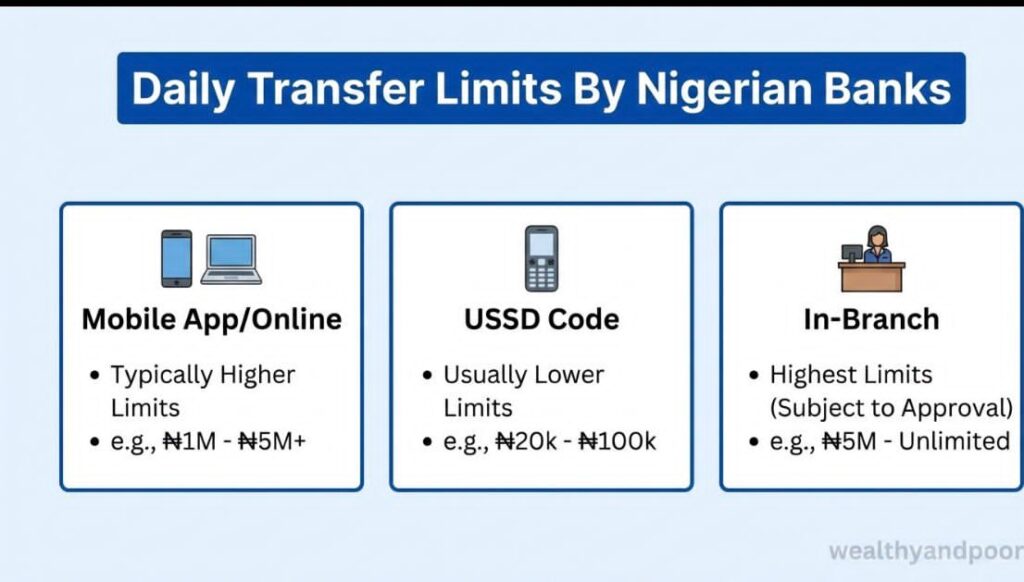

Understanding daily transfer limits is essential if you bank in Nigeria whether you’re sending money to family, paying vendors, or managing business finances.
These limits can vary widely based on the bank, how you access the account (USSD, mobile app, internet banking), and your account type. They are designed to balance customer convenience with fraud prevention and regulatory compliance.
Why Daily Transfer Limits Exist
Daily transfer limits exist for several reasons:
- Fraud prevention: Lower limits help reduce large-scale unauthorized transfers.
- Regulatory compliance: The Central Bank of Nigeria (CBN) sets guidelines to promote a safer, cashless economy.
Different channels require different controls: USSD (short code), mobile app, and internet banking each have different risk profiles, so limits differ. Larger limits often require more channels or documentation.
How Limits Vary by Bank and Channel
- Access Bank
On Access Bank’s USSD platform (like *901# or 901#):
Daily transfer limit on USSD: ₦100,000 for individual accounts.
Transfer to other banks via USSD: ₦20,000 per day.
Corporate accounts: Higher, up to about ₦1,000,000.
This highlights how limits can depend heavily on access method and account type.
- Guaranty Trust Bank (GTBank)
GTBank’s limits fluctuate depending on the channel:
USSD transfers: Usually around ₦200,000 per day.
Online/mobile app limits: Can allow up to ₦3,000,000 or higher for personal and business accounts.
Customers may request increases (subject to approval and risk checks).
This example shows that mobile app and internet banking allow much higher limits than USSD.
- Fidelity Bank
Fidelity Bank’s transfer limits vary by channel:
USSD: ₦20,000 per transaction and may have a cumulative daily cap of about ₦100,000.
Online banking: Typically allows up to ₦1,000,000 per day and can be increased to ₦5,000,000 with additional verification at a branch.
- First Bank of Nigeria
First Bank has different limits for different channels:
Mobile app and online banking: ₦500,000 per day (often higher with security tokens).
With advanced verification, corporate users or verified customers may transact up to ₦1,000,000–₦5,000,000 daily.
- Polaris Bank and Heritage Bank
These banks typically set:
Polaris Bank Smart USSD: Around ₦50,000 daily via *833#.
Mobile app: Usually up to ₦500,000 daily.
- Heritage Bank: Some platforms allow up to ₦2,000,000 daily, depending on how the transfer is initiated.
- United Bank for Africa (UBA)
UBA’s limits include:
UBA USSD: Starts lower (e.g., ₦20,000).
UBA mobile or internet banking: Up to ₦1,000,000 daily for individuals and significantly higher (up to ₦10,000,000) for corporate accounts.
- Union Bank & Sterling Bank
Union Bank: USSD transfers often capped at ₦100,000 daily, with higher limits available when additional authentication is used.
- Sterling Bank: USSD daily limits start lower but are upgradable with registered numbers and stronger authentication.
Regulatory Notes Affecting Limits
- Central Bank of Nigeria Policies
- Some overarching rules from the CBN affect transfers and cash operations:
- The CBN places limits on agent banking transactions (like deposits and withdrawals via agents) at ₦100,000 per day for each customer, with a weekly cap of ₦500,000.
- The apex bank has set daily contactless payment limits (e.g., ₦50,000 daily for contactless transactions), separate from bank transfer limits.
These rules reflect the broader move toward a cashless economy and tighter fraud control.
Key Factors Influencing Your Limit
Your personal daily transfer limit may depend on:
- Account verification level
Fully verified customers (often Tier 3 or higher KYC level) qualify for higher limits.
- Channel used
**USSD (e.g., 901# or 737#): Lower limits due to security constraints.
Internet or mobile app: Higher limits with secure login credentials.
- Account type
Individual accounts usually have lower limits.
Corporate or premium accounts can be set much higher even several million naira per day depending on bank policies.
How to Increase Your Transfer Limit
To get higher limits, you can:
- Visit your bank branch to provide additional KYC documents.
- Enable more secure channels, like mobile and Internet banking instead of just USSD.
- Request a limit increase via customer service or completed indemnity forms.
Where to Verify Latest Limits
For the most accurate and current information:
- Visit your bank’s official website or FAQ page.
- Check your mobile banking app’s settings or limit page.
- Contact customer support directly.
Many banks publish transfer limit FAQs online for example Zenith Bank includes current daily transfer limit info in its wallet FAQ section.
Conclusion
Daily transfer limits by Nigerian banks sit at the delicate intersection of security and convenience. On one hand, they reflect a necessary response to the realities of financial crime in a rapidly digitizing economy.
On the other, they highlight the growing pains of a banking system trying to protect its customers without slowing them down.
What this policy ultimately reveals is a deeper shift in Nigerian banking from speed at all costs to controlled, accountable transactions.
Yet, for the system to truly serve the people it was designed for, transparency, flexibility, and customer education must evolve alongside regulation. When customers clearly understand their limits and have realistic pathways to adjust them, trust grows. And in banking, trust is currency.
As Nigeria’s financial landscape continues to expand, the conversation around transfer limits should not end at restriction, but move toward balance where safety does not stifle productivity, and regulation empowers rather than frustrates. In finding that balance, Nigerian banks have an opportunity not just to secure transactions, but to redefine customer confidence in the digital age.











Comments