
How Inflation Affects Bank Stocks

A Double Edged Sword for Banks
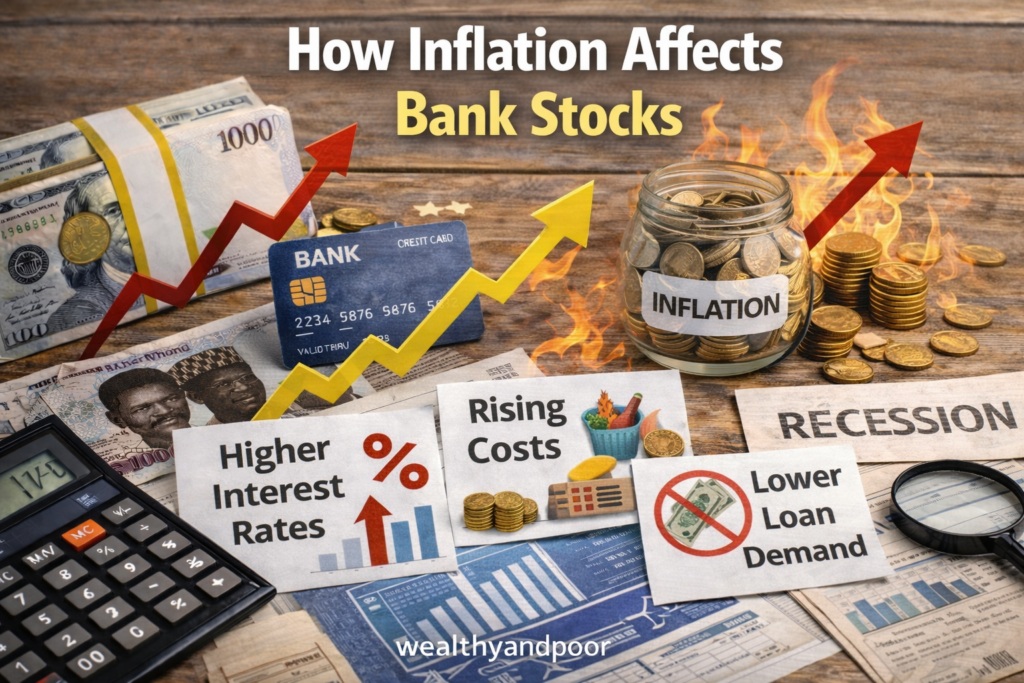
Inflation is often described as a silent tax on consumers. But for banks, it is something far more complex: a shifting landscape of risk and opportunity. When inflation accelerates, central banks respond with tighter monetary policy.
Interest rates rise. Borrowing costs increase. Consumer purchasing power weakens. Corporate margins shrink.
At first glance, higher interest rates seem like good news for banks. After all, banks earn money from lending. But the reality is more nuanced. Inflation can initially boost profitability and then quietly erode it. It can lift margins while simultaneously increasing credit risk. It can strengthen revenues in one quarter and destabilize loan portfolios in the next.
Understanding how inflation affects bank stocks requires examining how it interacts with interest rates, loan quality, deposit behavior, capital strength, and investor sentiment.
The Interest Rate Channel: Boosting or Compressing Margins
Banks generate most of their income through net interest income (NII) the difference between interest earned on loans and interest paid on deposits.
A key metric here is Net Interest Margin (NIM):
- NIM = Net Interest Income ÷ Average Earning Assets
- When inflation rises, central banks often increase policy rates to cool the economy. Higher rates typically allow banks to charge more on new loans. If deposit costs rise more slowly than lending rates, NIM expands.
However, the benefit depends on timing. If funding costs (especially deposits) rise quickly, or if the yield curve flattens, margin expansion may be limited. Therefore, inflation-driven rate hikes can either enhance or squeeze profitability depending on the structure of the bank’s balance sheet.
- Deposit Sensitivity and Funding Costs
Inflation influences depositor behavior.
When inflation is high:
- Consumers demand higher yields on savings.
- Depositors may shift funds to money market instruments.
- Banks must raise deposit rates to retain customers.
- If deposit costs increase faster than loan yields, NIM compresses.
Additionally, if inflation expectations remain elevated, customers may reduce savings altogether to preserve purchasing power, potentially slowing deposit growth.
Liquidity standards that govern funding stability are outlined by the Bank for International Settlements under Basel III:
Deposit stability is critical. A bank with sticky, low cost deposits benefits during inflationary cycles. A bank reliant on rate sensitive wholesale funding faces greater pressure.
- Credit Risk: Inflation’s Delayed Impact
One of inflation’s most underestimated effects on banks is rising credit risk.
When prices increase rapidly:
- Household budgets tighten.
- Businesses face higher input costs.
- Profit margins compress.
- Loan repayment capacity weakens.
While early phases of inflation may coincide with economic growth, prolonged high inflation can slow GDP and increase defaults.
The World Bank tracks nonperforming loans (NPLs), a key indicator of credit stress:
Banks respond by increasing loan loss provisions, which reduce net income.
Thus, even if interest income rises, rising credit provisions may offset gains.
- Asset Valuation and Securities Portfolios
Banks often hold government bonds and other fixed income securities.
Inflation typically leads to higher interest rates. When rates rise, bond prices fall. This creates unrealized losses in securities portfolios.
If banks classify these securities as “available for sale,” mark-to-market losses can reduce equity capital.
The SEC provides guidance on financial reporting and balance sheet analysis.
Significant unrealized losses can weaken capital ratios and trigger investor concern even if the bank intends to hold securities to maturity.
- Capital Adequacy Under Inflationary Stress
Rising inflation introduces volatility into risk-weighted assets and earnings.
Regulators require banks to maintain minimum capital levels, such as the Common Equity Tier 1 (CET1) ratio, under Basel III standards.
If inflation leads to:
- Higher loan defaults
- Securities valuation losses
- Slower earnings growth
- Capital ratios may weaken.
When capital buffers appear thin, investors demand higher risk premiums, often pushing bank stock prices lower.
- Loan Demand: Inflation’s Mixed Signal
In moderate inflation environments, loan demand may initially rise as businesses borrow ahead of further price increases.
However, sustained high inflation can:
- Reduce real household income
- Slow housing markets
- Dampen business expansion
Eventually, loan growth weakens.
Since bank valuations depend on expected earnings growth, declining loan demand can negatively affect stock prices.
- Cost Pressures and Operating Expenses
Inflation does not only affect revenue it also increases operating costs:
- Staff salaries rise.
- Technology expenses increase.
- Infrastructure and compliance costs climb.
- If cost growth outpaces revenue expansion, efficiency ratios deteriorate.
Banks closely monitor their cost to income ratio. Rising inflation can widen this ratio if expense control is weak.
- Investor Sentiment and Valuation Multiples
Inflation influences broader market psychology.
High inflation creates uncertainty about:
- Future rate paths
- Economic growth stability
- Regulatory response
- Uncertainty raises risk premiums.
Even if bank earnings are temporarily strong, valuation multiples (price to earnings or price-to-book ratios) may contract.
Bank stocks are particularly sensitive to macroeconomic expectations because they are deeply embedded in the economic cycle.
- The Yield Curve Effect
Inflation often reshapes the yield curve.
If short term interest rates rise faster than long term rates, the yield curve flattens or inverts. Banks borrow short-term and lend long-term. A flatter curve compresses margins.
A persistently inverted yield curve is historically associated with recession risks, which further pressure bank valuations.
Conclusion:
Inflation as Both Catalyst and Threat
Inflation affects bank stocks through multiple interconnected channels:
It influences interest margins.
It alters deposit behavior.
It increases credit risk over time.
It impacts bond valuations.
It pressures capital buffers.
It reshapes investor sentiment.
In moderate, well managed inflationary environments, banks can benefit from higher rates and expanded margins. However, prolonged or volatile inflation tends to introduce credit deterioration, valuation losses, and economic slowdown all of which weigh on bank stocks.
For investors, the key is not asking whether inflation is “good” or “bad” for banks. The real question is:
How sensitive is the bank’s funding base?
How diversified is its income?
How strong are its capital buffers?
How resilient is its loan portfolio?
Bank stocks do not react to inflation in isolation. They react to the interaction between inflation, monetary policy, and economic stability.
Understanding that interaction is what separates reactive investing from informed financial analysis.











Comments