
Nigerian Bank Account Types: Tier 1,2,3 – Explained

Bank account tiers levels assigned to accounts based on how much personal information and documentation the account holder has provided. The higher your tier, the higher your transaction limits and access to banking services in Nigeria.
The first known attempt at ranking Nigerian Banks into Tiers was made by analysts at Afrinvest, Lagos-based research, and financial advisory firm, in its 2013 Banking Sector Report.
Despite its importance, many bank customers are unaware of how account tiers work until they encounter failed transfers, withdrawal limits, or account restrictions. With digital banking becoming the primary means of financial transactions in Nigeria, understanding bank account tiers has become essential for individuals, students, salary earners, and business owners alike.
The tiered account structure serves multiple regulatory and operational purposes.
By adopting this system, banks are able to extend services to under banked populations, while ensuring that higher-value transactions are carried out on fully verified accounts.
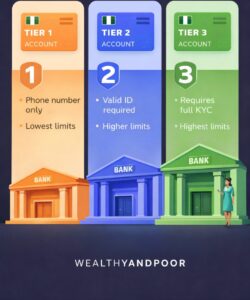
your tier controls how much freedom your account has
Why Nigerian Banks Use Account Tiers
The system exists for several practical reasons:
- To prevent fraud and identity theft
- To comply with CBN regulations
- To allow people without full documents to still access banking
- To control transaction risks on unverified accounts
This is why a student, small trader, and salary earner may all use the same bank but operate on different tiers.
Tier 1 Account in Nigeria (Basic Account)
A Tier 1 account is the most basic type of bank account in Nigeria. It is designed for people who want quick access to banking services with minimal documentation.
Requirements for Tier 1 Account
Most Nigerian banks require only:
- Phone number
- Full name
- Date of birth
- Passport photograph or selfie
- No utility bill. No ID card in most cases.
Transaction Limits
While limits vary slightly by bank, Tier 1 accounts generally allow:
- Daily transfer limit: up to ₦50,000
- Maximum account balance: usually ₦300,000
- Limited withdrawals
Who Tier 1 Is Best For
- Students
- Low-income earners
- People opening their first bank account
- Those without valid ID or proof of address
Limitations
- Very low transfer limits
- Cannot receive large payments
- Some bank services are restricted
Tier 2 Account in Nigeria (Intermediate Account)
A Tier 2 account offers more flexibility than Tier 1 and is the most common type used by everyday Nigerians.
Requirements for Tier 2 Account
- Valid government-issued ID (NIN, voter’s card, driver’s license, or international passport)
- Passport photograph
- Basic personal details
- No utility bill is required for most banks at this level.
Transaction Limits
Typical Tier 2 limits include:
- Daily transfer limit: ₦200,000 – ₦500,000
- Higher withdrawal limits
- Increased account balance capacity
Who Tier 2 Is Best For
- Salary earners
- Small business owners
- Freelancers
- NYSC members
Advantages
- Higher transaction freedom
- Fewer failed transfers
- Access to ATM, mobile banking, and USSD without major restrictions
Tier 3 Account in Nigeria (Fully Verified Account)
A Tier 3 account is the highest level of verification available to individual account holders in Nigeria. It gives you full banking access with the highest limits.
Requirements for Tier 3 Account
- Valid government-issued ID
- Utility bill or proof of address
- Completed KYC form
Transaction Limits
- Daily transfer limit: ₦1,000,000 and above
- Very high or unlimited account balance
- Full access to all banking services
Who Tier 3 Is Best For
- Business owners
- High-income earners
- Entrepreneurs handling large transactions
- Professionals receiving foreign or bulk payments
Advantages
- Highest limits
- Fewer transaction declines
- Priority banking services in some banks
How to Upgrade Your Nigerian Bank Account Tier (Step-by-Step)
- Check your current account tier using your bank app or USSD code
- Gather the required documents for the next tier
- Visit your bank branch or use in-app upgrade options
- Submit documents and biometric verification if required
- Wait for confirmation (same day to a few working days)
Some banks allow upgrades fully online, while others still require branch visits for Tier 3.
How Long It Takes to Upgrade
Tier 1 to Tier 2: Same day to 24 hours
Tier 2 to Tier 3: 1–5 working days
Delays may occur if documents are unclear or verification fails
Frequently Asked Questions ( FAQs)
Q1. Can I receive large amounts with a Tier 1 account?
No. Tier 1 accounts have strict balance and transfer limits.
Q2. Is NIN compulsory for Tier 2?
Most banks accept NIN or any valid government ID.
Q3.Can students open Tier 3 accounts?
Yes, if they can provide all required documents.
Q4. Do all banks use the same limits?
No, limits vary slightly by bank but follow CBN guidelines.
Q5.Can I downgrade my account tier?
Usually no, unless the bank flags compliance issues.
In Conclusion: Understanding Nigerian bank account tiers is one of those small financial knowledge pieces that can save you a lot of stress in the long run. Tier 1, Tier 2, and Tier 3 accounts are not just labels given by banks; they directly affect how freely you can use your money. From transfer limits and withdrawal caps to the types of services you can access, your account tier quietly controls your everyday banking experience. This is why many people face unexpected transaction failures — not because their bank app is faulty, but because their account tier cannot handle the amount involved.
Tier 1 accounts are ideal for basic banking needs and financial inclusion, especially for students and individuals just entering the banking system. Tier 2 accounts suit most working Nigerians, offering higher limits without the stress of providing proof of address. Tier 3 accounts, on the other hand, are best for business owners, professionals, and anyone who regularly handles large sums of money and needs full access to banking services without constant restrictions.











Comments