
What Happens If You Exceed Account Limits

Understanding the Consequences of Going Beyond Your Financial Boundaries
In Nigeria today, many people rely on bank accounts and credit facilities from daily savings accounts and e- wallets to credit cards and overdraft services to manage money, pay bills, or buy goods online.
But what happens when you accidentally (or unknowingly) go beyond the allowed limit of one of these accounts? Does your bank block you? Do you lose money? Does it affect your financial reputation?
This article breaks it down clearly and practically, so you know exactly what to expect whether you’re using a savings account, debit card, or a credit card.
What Is an “Account Limit”?
An account limit refers to the maximum amount you are allowed to hold, spend, or withdraw from a financial account. Different types include:
- Bank account balance limit (especially tiered accounts like NYSC or basic savings accounts in Nigeria).
- Daily transaction limits, especially when you use USSD (e.g., *901#), mobile app, or internet banking.
- Credit card limits, which define how much you can borrow on that card.
Every financial institution sets these limits based on regulations, security requirements, and your level of account verification (KYC — Know Your Customer). Without full verification (e.g., BVN, ID, address), your account will often have lower limits.
What Happens if You Exceed a Bank Account Balance Limit?
This situation is most common in accounts that are tiered or have daily transaction restrictions for example, when opening a bank account or e- wallet without full verification.
Immediate Consequences
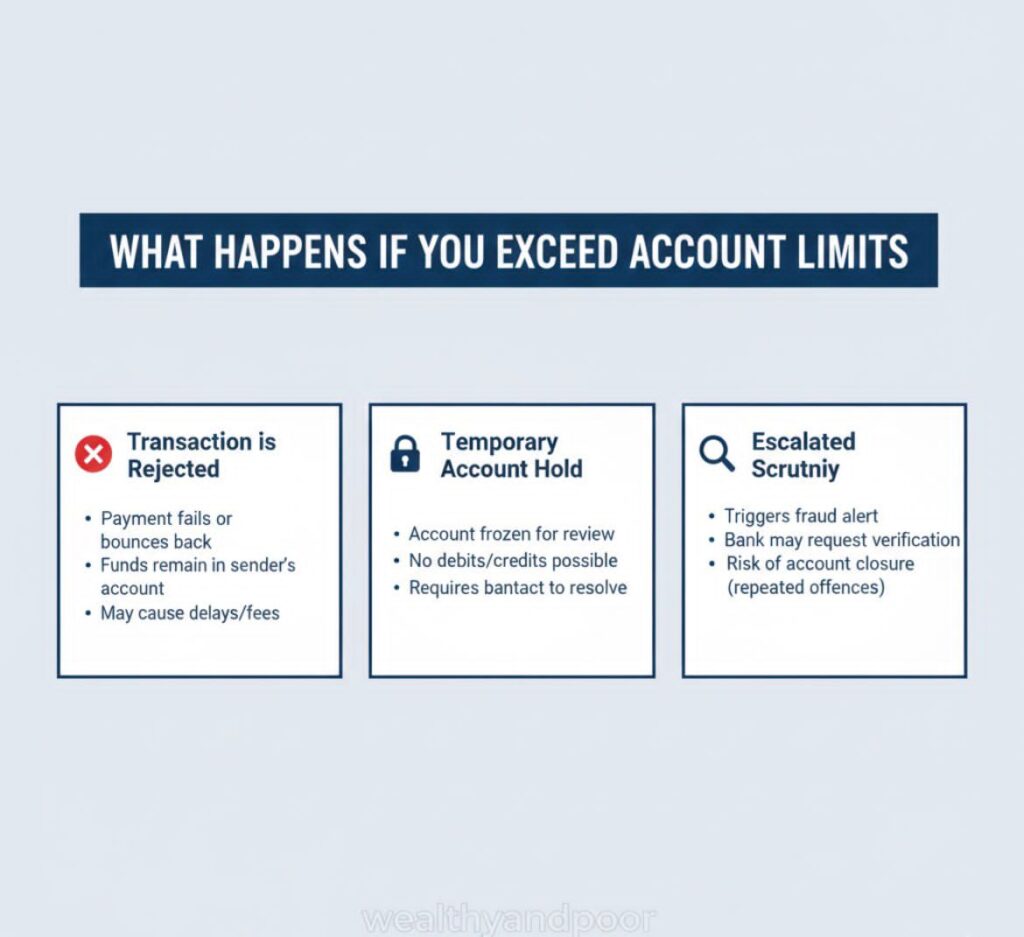
- Transactions will be rejected or declined. If the system detects you are about to exceed the limit, it stops the transfer or withdrawal.
- Your account could be temporarily restricted. In Nigeria, banks might place restrictions until you complete full KYC documentation (like BVN, valid ID).
Why This Happens
Regulators in Nigeria (like the Central Bank of Nigeria — CBN) require certain limits for customer safety and fraud prevention. If an account is not fully upgraded to a higher tier, it simply cannot hold more money than the allowed maximum. Exceeding this means the system refuses further action until the limit is addressed.
What Happens if You Exceed Your Credit Card Limit?
Credit cards work differently. Here, exceeding the limit can have financial and credit consequences.
- Transactions Can Be Declined
Most credit card systems automatically prevent purchases that would push you beyond your limit. That means the card simply won’t work for that purchase.
Many issuers do this even if you have opted in to allow over-limit charges.
- You Might Be Charged an Over Limit Fee
In places like the United States, credit card issuers may charge a fee when you exceed your credit limit but only if you have given prior permission for such charges.
In practice:
- The fee usually cannot exceed how much you’re over.
- The law often limits how often the fee can be charged.
In Nigeria: banks may or may not allow over limit purchases; if they do, similar penalty fees can apply usually spelled out in your credit card agreement.
- Higher Interest Rates
If you go over your limit, some issuers might:
- Increase your interest rate (A P R) — meaning you pay more on outstanding balances.
Apply a penalty A P R that remains until you show consistent payment behaviour.
- Negative Impact on Your Credit Score
Exceeding your limit usually raises your credit utilization ratio the percentage of credit you’re using compared to what you’re allowed.
A high utilization ratio negatively affects your credit score and can make future credit (like loans or mortgages) harder or costlier to get.
- Larger Minimum Payments
Your minimum monthly payment could rise because it is partly calculated based on how much you owe. This makes it more expensive to repay over time.
- Account Freezing or Closure
If you regularly exceed the limit or fail to pay down the balance quickly, the issuer might:
- Freeze your account,
- Reduce your credit limit,
- Or even close your account.
Longer-Term Consequences
Exceeding limits doesn’t always just cost you extra now it can shape your financial future:
- Reduced trust from lenders banks see limit breaches as risky behaviour.
- Harder access to credit future loan or card applications can be declined or carry higher interest.
- Bad financial reputation a credit history with frequent limit violations can stay on record for years.
How to Avoid or Fix Limit Issues
Here are practical tips to protect yourself:
- Monitor Your Accounts Regularly
Use banking apps and SMS/USSD alerts so you always know where your balance or available credit stands.
- Upgrade Your Account
In Nigeria, complete your BVN and KYC so your limits are higher and you’re not easily blocked.
- Set Alerts
Many cards and banks offer warnings when you approach your limit. Use them!
- Pay Down Balances Quickly
If you accidentally go over, quickly paying down the balance can prevent or reduce negative impacts.
- Request a Credit Limit Increase
If you have good history and income, your card issuer might raise your limit reducing the chance of exceeding it.
Conclusion:
Limits Matter But So Does Discipline
Exceeding account limits, whether in a bank account or credit card, isn’t just a system error it has real consequences. In bank accounts, it often stops your transaction or places a restriction. On credit cards, it can cost you fees, higher interest, a lower credit score, or even account restrictions.
The better you understand your limits and manage your money proactively, the less likely you’ll face financial penalties or future headaches.











Comments