
Why Bank Apps Crash During Peak Hours
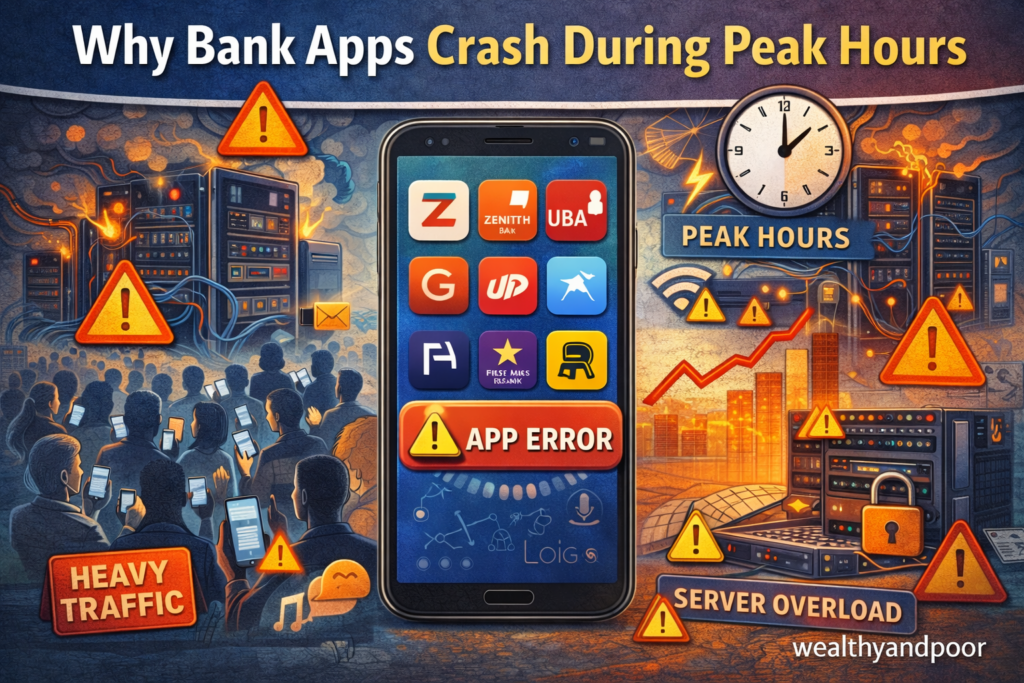

In an era where digital banking promises speed, convenience, and 24/7 access, few things are as frustrating as a bank app freezing just when it matters most. Across Nigeria and many emerging markets, customers have come to expect a familiar pattern: try to transfer money during salary periods, bill deadlines, or Monday mornings and the app slows to a crawl or crashes entirely.
This recurring problem is not random. It is the result of a complex mix of infrastructure limitations, software design flaws, and systemic pressures within the banking ecosystem. Understanding why bank apps fail during peak hours reveals deeper truths about how modern financial systems are built and where they fall short.
The Nature of Peak Banking Traffic
Peak hours in digital banking are highly predictable. They often occur at the end and beginning of the month when salaries are paid, bills are due, and businesses settle accounts. During these periods, millions of users attempt to access their accounts simultaneously.
The spike in demand is not gradual it is explosive. A banking system that comfortably handles tens of thousands of transactions per minute during normal periods can suddenly face traffic many times higher.
This surge creates a digital “rush hour,” where systems designed for average usage are overwhelmed by synchronized demand.
Infrastructure Limitations: Built for Average, Not Extremes
At the heart of the problem lies infrastructure. Many banks design their systems to handle typical daily traffic rather than extreme peaks. This is largely a cost decision.
Building infrastructure capable of handling maximum demand at all times would require massive investment in servers, bandwidth, and data centers resources that would sit idle during off peak periods. As a result, banks often operate with limited buffer capacity.
When demand exceeds this capacity, systems begin to slow down. Eventually, they stop responding altogether.
Another key issue is the reliance on outdated or legacy systems. Many banks still operate core platforms developed over a decade ago long before mobile banking usage reached current levels. These systems were never designed to handle millions of real-time mobile transactions.
Network Congestion and Bandwidth Bottlenecks
Even when internal systems are functional, network limitations can trigger failures. Banking apps depend on multiple layers of connectivity:
- Internet service providers
- Telecom networks
- Internal bank networks
During peak hours, these networks experience congestion similar to traffic jams on a busy highway. When too many requests attempt to pass through limited bandwidth channels, delays occur and eventually, requests begin to fail.
For users, this appears as slow loading times, failed transfers, or apps that refuse to open.
Database and Processing Overload
Every banking transaction requires database interaction checking balances, validating accounts, and recording transactions. When thousands of users make requests simultaneously, databases become a major bottleneck.
Poorly optimized databases struggle under heavy load. Instead of processing requests efficiently, they slow down dramatically or crash entirely.
In many cases, the issue is not just volume but inefficiency. Repeated queries, lack of caching, and outdated database structures increase the strain on already overloaded systems.
Software Design Challenges
Beyond hardware, the architecture of banking applications plays a critical role.
Many systems still rely on synchronous processing, meaning each transaction must be completed before another begins. During peak periods, this creates long queues that grow exponentially.
Other common issues include:
- Poor optimization: Inefficient code consumes excessive resources
- Weak caching systems: Repeated data requests overload servers
- Session failures: Users are logged out and forced to log in again, increasing traffic
- Poor error handling: Users retry failed transactions repeatedly, worsening the load
These design flaws compound the impact of high traffic, turning slowdowns into full scale crashes.
Dependence on Third-Party Systems
Banking apps do not operate in isolation. A single transaction may involve multiple external systems, including:
- Interbank settlement platforms
- Card networks
- Bill payment processors
- Identity verification services
If any one of these systems experiences delays or outages, the entire transaction can fail even if the bank’s own app is functioning correctly.
During peak hours, these third party systems are also under pressure, increasing the likelihood of failure across the entire network.
Security Processes Add Extra Load
Banking apps must maintain strict security protocols, including encryption, fraud detection, and authentication checks. These processes consume computing power and cannot be relaxed during high traffic periods.
As transaction volume increases, security systems must process more data, adding further strain on already stretched resources.
The Human Factor: User Behavior Amplifies the Problem
Ironically, user behavior often worsens system overload.
When a transaction fails, most users immediately retry sometimes multiple times. Each retry adds more traffic to an already congested system.
In addition, many users tend to perform transactions at the same time:
- Right after salary alerts
- Just before payment deadlines
- During workday mornings
This synchronized behavior creates massive spikes rather than evenly distributed usage.
Business and Economic Realities
A less obvious but important factor is the business incentive structure within banks.
Upgrading infrastructure to handle peak demand is expensive. Yet, many customers continue using their banks despite app failures, meaning there is limited competitive pressure to improve.
Moreover, regulatory requirements for app performance are often minimal. Without strict service-level expectations, banks may prioritize short-term profitability over long-term infrastructure investment.
The Bigger Picture: A System Under Strain
The frequent crashing of bank apps during peak hours reflects a broader challenge: digital adoption is growing faster than infrastructure can keep up.
As more Nigerians embrace mobile banking, transaction volumes continue to rise. However, without corresponding investment in scalable systems, the gap between demand and capacity widens.
Conclusion
Bank app crashes during peak hours are not simply technical glitches they are the visible symptoms of deeper structural issues. From underpowered infrastructure and legacy systems to software inefficiencies and third-party dependencies, multiple factors converge to create failure at the worst possible moments.
Solving this problem will require significant investment in scalable technology, better system design, and stronger regulatory oversight. Until then, users may continue to experience the frustrating reality of digital banking: convenience except when everyone else needs it too.












Comments