
Why Banks Reject Utility Bills And How Long Account Upgrade Takes

If you’re a Nigerian trying to upgrade your bank account tier, link your phone number, or simply verify your identity for better banking limits, you’ve likely faced rejection of your utility bill.
It’s frustrating when you upload what you think is a valid document, only to get a notification hours or days later that it’s unacceptable.
Whether you’re a student, entrepreneur, or wage earner, this hurdle feels all too familiar. Many Nigerians have even spent days gathering multiple documents or going back and forth to the bank just to satisfy what seems like a simple requirement.
But why does this keep happening, and how long should you really expect the upgrade process to take?
Know Your Customer (KYC) -Why Banks Ask for Utility Bills;
At the heart of most rejections is regulation. Nigerian banks operate under strict Know Your Customer (KYC) and anti money laundering rules issued by the Central Bank of Nigeria (CBN).
Part of these regulations is to confirm a customer’s identity and residential address before allowing higher account limits, certain features, or even linking contact information.
Though not published line by line in one public CBN document, these rules shape banks’ internal policies and cause utility bills to be a standard proof of address requirement.
A 2012 financial inclusion report noted that utility bills are one of the main documents banks expect for proof of address under verification frameworks in Nigeria.
In fact, many banks list utility bills, electricity, water, waste, internet bills as accepted proof of address when applying for account upgrades. For example, a widely referenced account upgrade interface shows that customers must upload a utility bill not older than six months as part of Tier upgrade submissions.
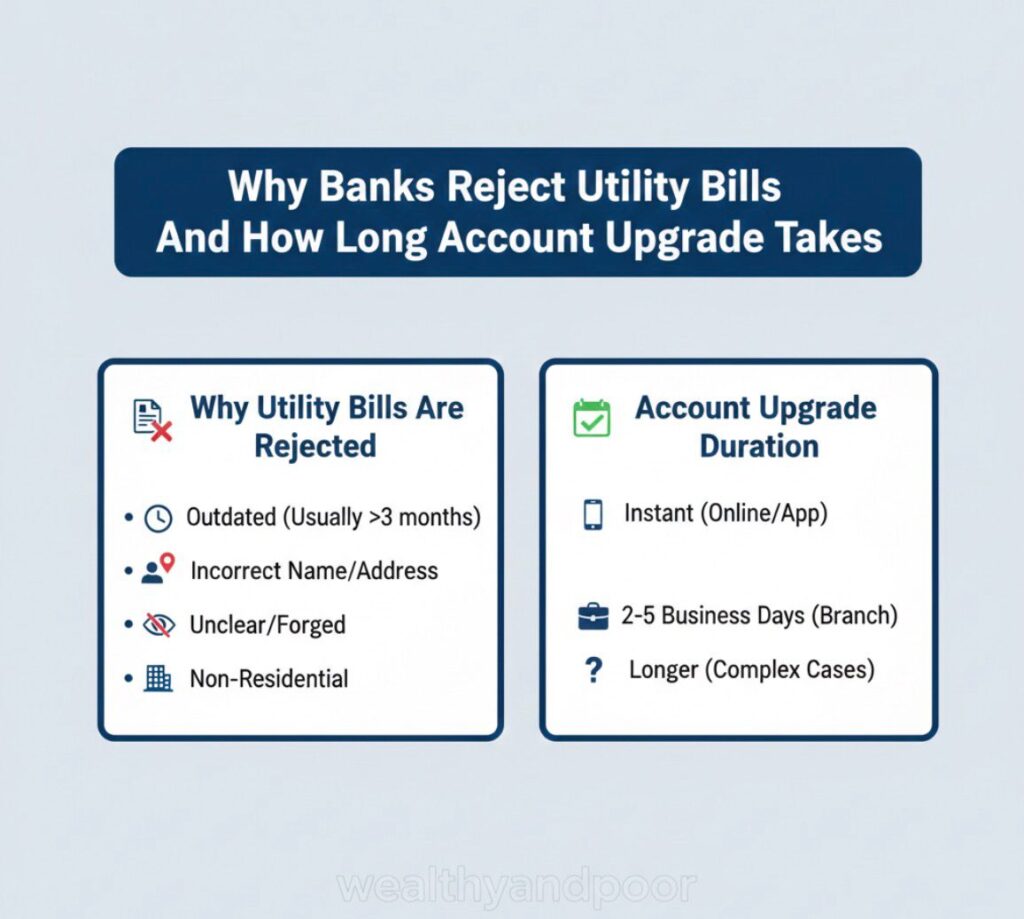
Common Reasons Banks Reject Utility Bills
Here are the major reasons a utility bill is rejected and trust me, it isn’t always your fault:
- Mismatched Address or Name :
If the address on the bill doesn’t match what the bank has on file, that’s an instant reject. Banks want exact matches. This includes house number, street name, and even spelling consistency. - Bill Too Old :
Many banks require recent proof often within 3 to 6 months. A bill from eight months ago typically won’t cut it. - Not in Your Name :
This is one of the biggest pain points in Nigeria: most people live in family homes or rented places where the electricity or water bill is under a landlord’s name. Unless banks accept alternative documents or a landlord’s utility bill with a signed letter, this leads to a rejection. - Poor Document Quality :
Blurry scans, cropped edges, and screenshots with missing details get bounced quickly. Quality matters. The bank must be able to read the entire document clearly. - Unsupported Utility Types :
Bills from certain apps or platforms without clear provider names (like some prepaid electricity receipts) might not be considered official.
Alternative Proof of Address What Else Can You Use?
If you don’t have a utility bill in your name, you’re not out of options. Nigerian banks often accept other proof of address forms provided they meet requirements:
- Recent bank statements stamped with your address
- Signed tenancy agreements
- Official letters from employers,
- educational institutions, or traditional authorities
- Government IDs that include address details
- Utility bills in a relative’s name plus a supporting affidavit or confirmation letter
Some banks are more flexible than others; for example, GTBank’s online upgrade system accepts several types of address proof if they clearly confirm your residence.
The Account Upgrade Timeline — What to Expect
One of the most asked questions is: “How long will this take?”
While exact timelines vary by bank and your documentation quality, here’s a realistic range based on current banking processes:
- Standard Expected Timeline
24 to 72 hours (1–3 business days) This is typical for digital or online document submission and verification, if all documents are correct.
Up to 5–7 days or more If your documents are unclear, mismatched, or require manual review.
Many Nigerian customers report waiting several extra days before hearing back from bank support.
In most Nigerian banks that allow online upgrade or upload (like via their app or portal), the bank will review your documents and notify you once approved often through SMS or in app notifications.
What Slows Down the Upgrade Process
Even when you think you did everything right, several issues can drag the process out:
- Backlogs at the Bank
During peak periods or if many people are upgrading at once, reviews take longer. - Mismatched BVN / NIN Details
If your Bank Verification Number (BVN) and National Identification Number (NIN) don’t perfectly match or are missing, the system may hold your upgrade longer. - System Limitations
Sometimes uploads don’t register, or bank systems glitch and you only find out when notified of rejection.
Practical Tips to Increase Your Chances of Success
Here are ways to avoid a rejected utility bill or delays:
- Confirm that names and address details perfectly match your bank’s records.
- Upload high-quality scans or clear photos of your documents.
- Use latest copies (ideally within 3 months).
- If your utility is not in your name, pair it with a supporting letter.
- Always check your BVN and NIN are correctly linked and updated.
- Use bank support if you don’t understand rejection reasons.
Conclusion
Understanding the System Helps You Sail Through
Banking processes that feel slow or annoying usually have strong regulatory reasons behind them. Nigerian banks reject utility bills most commonly due to mismatches, outdated documents, or unreadable submissions all rooted in CBN’s strict KYC requirements. Upgrading your account doesn’t need to take forever; with correct, clear, and compliant documents, many Nigerians see upgrades approved in 1–3 business days.
Grasp these details, take your time to prepare documents correctly, and you’ll avoid repeated rejections and long waiting periods.







Comments