
Why Nigerian Banks Deduct ₦50 Naira From Transfers


For many Nigerians, receiving a debit alert for ₦50 immediately after sending money has become a familiar experience—one that often leaves customers asking, “Why did my bank remove ₦50?” With the rise of digital banking, mobile transfers, and instant payments, this deduction appears more frequently than ever. Yet very few people fully understand why it happens, who collects the money, whether it is avoidable, or how it interacts with other charges imposed by Nigerian banks. So down to why Nigerian Banks Deduct ₦50 From Transfers.
The ₦50 charge is not a bank fee:
It is a government-mandated levy known as the Electronic Money Transfer Levy (EMTL), introduced by the Finance Act and implemented through the Central Bank of Nigeria.
The EMT Levy applies to all electronic transfers above ₦10,000, whether you are using mobile banking, USSD, ATM transfer, or a fintech platform. This means that anytime you transfer more than ₦10,000, your bank deducts ₦50 and remits it to the Federal Government.
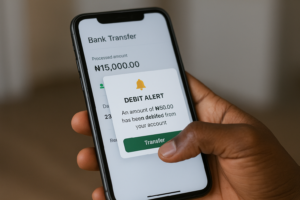
Many customers assume that the ₦50 is part of general bank charges, but it is not. Banks only act as collection agents; they do not keep the money.
The confusion comes from the fact that bank customers already deal with several small charges some as low as ₦4.38, ₦11.25, or ₦15.00 making it difficult to know what each deduction represents.
Banks frequently deduct charges such as:
- VAT on banking services
- SMS alert fees
- Card maintenance fee
- Transfer fees
- ATM withdrawal charges
- Stamp duty on deposits (different from the ₦50 levy on transfers)
Moreover, these micro-charges appear side by side with the ₦50 EMT Levy, customers often believe everything is coming from the bank:
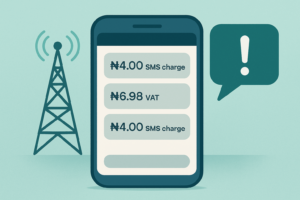
- When a customer sees ₦11.25, ₦6.98, or ₦4.38 deductions, these often come from SMS alerts, VAT or small service charges.
- When you withdraw after your third ATM usage at another bank, you get charged ₦35.
- When you receive money above ₦10,000, stamp duty applies.
- When you use or maintain a debit card, banks apply quarterly card maintenance fees.
When VAT applies to banking services, it shows up as small deductions that many customers mistake for illegal charge.
When the ₦50 Charge Applies and When It Does Not
The ₦50 EMT Levy applies only when a bank customer initiates an electronic transfer above ₦10,000.
If you send:
₦2,000 → No ₦50 charge
₦9,500 → No ₦50 charge
₦10,100 → ₦50 charge
₦150,000 → ₦50 charge
₦500,000 → ₦50 charge
Regardless of the transfer amount, once it is above ₦10,000, the levy applies.
- It applies to both interbank and intrabank transfers above ₦10,000.
- Digital banks (Kuda, Opay, Palmpay, Moniepoint, etc.) must also deduct it.
- It applies whether you use an app, USSD, ATM, or POS transfer.
- It does not apply to bank deposits, only transfers.
- Deposits above ₦10,000 fall under Stamp Duty, not the EMT Levy.
Why the Charge Appears More Frequently Today:
As digital payments grow across Nigeria—supported by NIBSS data showing over 80% increase in e-payments—customers now transfer money more often than ever.
Instead of using cash for everyday transactions, people now:
- Buy food via transfer
- Pay POS agents via transfer
- Send money for transport via transfer
- Pay rent via transfer
- Pay bills via transfer
- Every increase in digital transactions naturally increases the number of ₦50 charges.
Why Nigerians Feel Overcharged:
When combined with SMS alert fees, small VAT deductions, ATM charges, card maintenance fees, transfer fees, and stamp duty, customers often feel that banks are “eating their money”.
How to Reduce the ₦50 Deduction
The ₦50 levy cannot be avoided entirely because it is mandatory.
However, customers can manage how often it occurs by:
- Bundling transfers instead of sending multiple small ones
- Sending amounts below ₦10,000 when making minor payment.
- Using internal wallet transfers within digital apps
- Using bank transfer alternatives for micro-payments.
“The rule is simple: Every transfer above ₦10,000 attracts ₦50.”
The ₦50 deduction Nigerian banks charge on transfers is not arbitrary, hidden, or fraudulent. It is a legally required levy imposed by the Federal Government through the Electronic Money Transfer Levy (EMTL). As digital banking grows, more people encounter the charge, making it feel like a “new” fee when it has always been a statutory obligation.
However, because Nigerian banking also contains several other micro-charges—SMS fees, VAT, stamp duty, ATM fees, card maintenance and more—understanding the ₦50 charge requires a broader understanding of the banking system.
Over the past few years, digital payments have grown sharply, driven by mobile banking, fintech innovations, and the rising culture of cashless transactions. However, a significant portion of this digital activity had remained outside formal taxation. By enforcing VAT on digital payments, the government hopes to capture value from the fast-growing online market and reduce overdependence on crude oil earnings.
In Addition, For businesses, especially SMEs, this development means they must become more deliberate about compliance. Many small brands using online payment gateways—like Paystack, Flutterwave, and bank transfer links—may now have to adjust their pricing models and ensure proper VAT filings. Financial analysts believe the move is necessary, but they warn that clarity and seamless implementation will be key to avoiding confusion among merchants already dealing with high operating costs.
At its core, the ₦50 EMTL is a statutory levy—not a hidden bank charge, not a scam, and not a new policy. It is simply part of Nigeria’s effort to formalize revenue collection in a rapidly growing digital economy and fostering accountability.











Comments (1)
Now I've got backed up proof as to where all my #50 had been going to. Well done Ma