
Why You Get Debited Twice for One Transaction
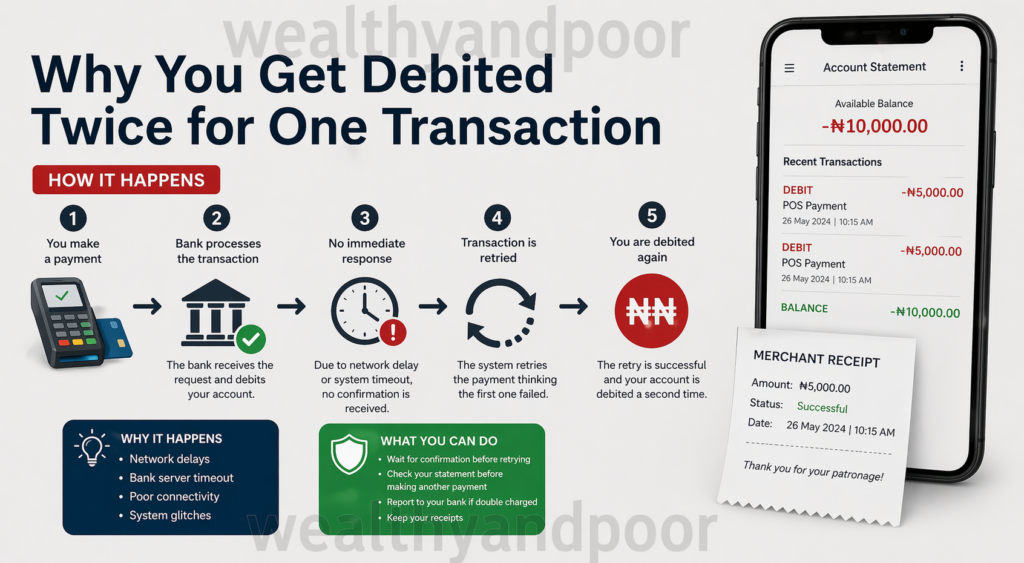

In today’s fast moving digital economy, bank transfers, card payments, and mobile transactions are expected to be instant and accurate. So when a customer notices that money has been deducted twice for a single transaction, the immediate reaction is often panic. Has the bank made a mistake? Has fraud occurred? Or is the system simply malfunctioning?
The truth is more nuanced. Double debits are relatively common in modern banking systems, and in most cases, they are temporary or reversible. Understanding why they happen requires a closer look at how payments are processed behind the scenes.
The Payment Journey: Why “Double” Doesn’t Always Mean Double
When you make a payment whether through a debit card, POS terminal, or online transfer the transaction does not move instantly from your account to the recipient. Instead, it goes through multiple stages: authorization, processing, and settlement.
At the authorization stage, your bank confirms that you have sufficient funds and temporarily “holds” the amount. This is known as a pre authorization hold. Later, when the merchant completes the transaction, the actual debit is processed. During this window, both entries may appear on your statement, creating the illusion of a double charge.
In many cases, the first entry disappears within a few hours or days once the transaction is finalized.
Common Reasons for Double Debits
- Pre-Authorization Holds
This is the most frequent cause. Businesses especially online stores, hotels, and fuel stations place a temporary hold on your funds before completing the transaction. Until that hold is released, your account may show two deductions.
- Network or Connectivity Issues
In regions with unstable internet connectivity, a payment may appear to fail even after it has gone through. The customer or merchant may attempt the transaction again, leading to two successful debits.
This is particularly relevant in developing markets where network interruptions are more frequent.
- Multiple Payment Attempts
Clicking the “Pay” button more than once during a slow online checkout can trigger duplicate charges. Similarly, tapping a contactless card multiple times or swiping repeatedly at a POS terminal can result in multiple authorizations.
- Merchant or POS Errors
Human or technical errors at the merchant’s end can also lead to duplicate processing. A cashier might mistakenly charge twice, or a payment terminal could resend a transaction due to a glitch.
- Pending vs. Posted Transactions
Sometimes what appears as a duplicate is simply a pending transaction alongside a completed one. Banks often display both until the pending entry clears, creating temporary confusion.
- System Glitches in Banking Networks
Occasionally, large-scale technical failures in payment processors or banking systems can result in widespread duplicate debits. Though rare, such incidents have affected thousands of customers at once, usually followed by automatic reversals.
- Duplicate Presentment
This occurs when the same transaction is submitted more than once for payment processing. While often accidental, it results in identical charges appearing on a bank statement.
Why the Money Often Comes Back
The reassuring part is that most double debits are not permanent. Banking systems are designed with reconciliation mechanisms that detect duplicate transactions. When identified, the extra charge is typically reversed automatically.
In some cases, you may see a “duplicate reversal” entry on your statement, which cancels out the extra debit and restores your balance.
However, the timing of reversals varies:
- Instant to 24 hours for simple authorization errors
- 1–5 business days for card transaction holds
- Up to several days for more complex disputes
When to Be Concerned
While most cases resolve themselves, there are situations where you should take action:
- If both charges are marked as completed, not pending
- If the duplicate debit remains after several days
- If the transactions are from unknown merchants
- If your account balance is significantly affected
In such cases, contacting your bank immediately is essential. You may also need to reach out to the merchant for clarification or request a refund.
How to Reduce the Risk
Consumers can take a few simple precautions to avoid double debits:
- Avoid clicking “Pay” multiple times during online transactions
- Wait for confirmation before retrying failed payments
- Keep transaction receipts and alerts for reference
- Use stable internet connections when making payments
- Regularly monitor your bank statements
The Bigger Picture: A System Built on Speed, Not Perfection
The rise of digital banking has dramatically improved convenience, but it has also introduced complexities. Payment systems today involve multiple players banks, payment processors, merchants, and networks and each step introduces a small margin for error.
Double debits are often a byproduct of this layered ecosystem rather than outright failures. While they can be frustrating, they rarely result in permanent financial loss.
Conclusion
Seeing your account debited twice for a single transaction can be alarming, but it is usually a temporary issue tied to how modern payment systems operate. From authorization holds to network glitches, the causes are often technical and short-lived.
The key is awareness. By understanding the process and knowing when to act, consumers can navigate these situations calmly and confidently turning what feels like a financial scare into a manageable inconvenience.












Comments