
Bond vs Stock Investment Comparison
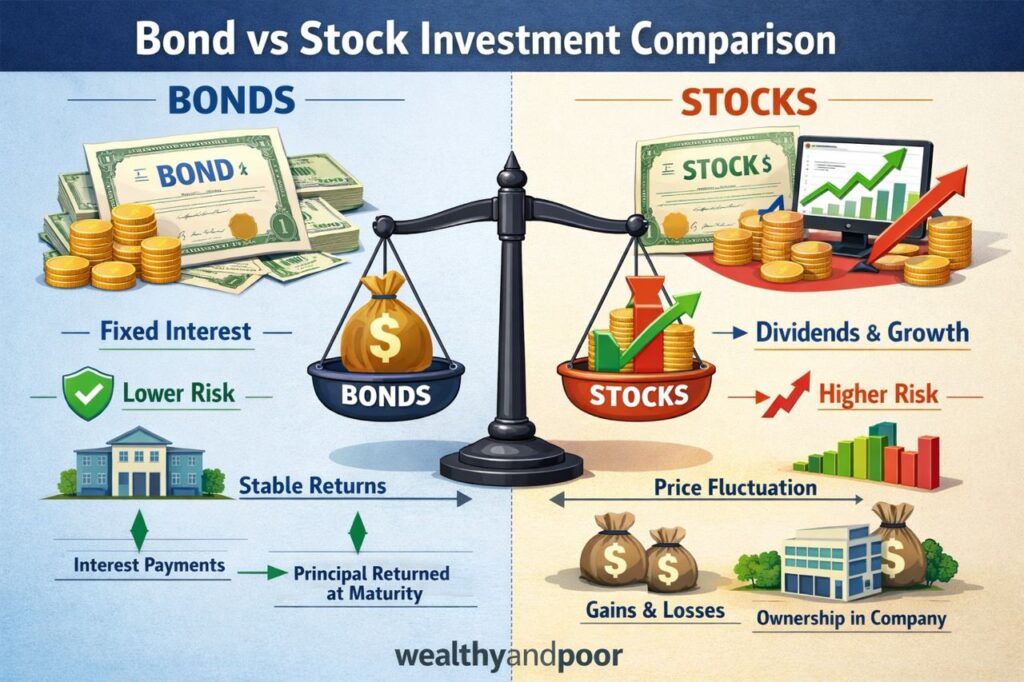

In the world of investing, few debates are as enduring or as important as the choice between bonds and stocks. These two asset classes form the backbone of most portfolios, yet they serve fundamentally different purposes. Understanding how they work, how they differ, and how they can complement each other is essential for anyone seeking to build long-term wealth.
This article offers a structured, practical comparison of bonds and stocks, examining their mechanics, risks, returns, and ideal use cases.
Understanding the Basics
At their core, stocks and bonds represent two different relationships between an investor and an issuer.
Stocks give you ownership in a company. When you buy shares, you are effectively buying a stake in that business, entitling you to a portion of its profits and growth.
Bonds, on the other hand, are loans. When you invest in a bond, you are lending money to a government or corporation in exchange for regular interest payments and the return of your principal at maturity.
This distinction ownership versus lending is the foundation upon which all other differences are built.
How Returns Are Generated
One of the most significant differences between bonds and stocks lies in how investors make money.
- Stocks: Growth and Capital Gains
Stock investors earn returns primarily through capital appreciation buying shares at a lower price and selling them at a higher one. In some cases, companies also distribute profits through dividends.
Because stock prices are tied to company performance and market sentiment, returns can vary widely. Historically, stocks have delivered higher long-term returns than bonds, often averaging around 8–10% annually in developed markets.
- Bonds: Fixed Income
Bond investors earn returns through interest payments, often referred to as coupon payments. These are typically predictable and paid at regular intervals.
Unlike stocks, bonds provide a defined income stream and return of principal (assuming no default), making them attractive to investors seeking stability.
Risk and Volatility
Risk is where the contrast becomes most pronounced.
- Stocks: Higher Risk, Higher Reward
Stocks are inherently volatile. Prices can fluctuate daily based on earnings reports, economic conditions, or even investor sentiment. If a company underperforms, the value of its shares can decline significantly.
However, this volatility is also what creates the opportunity for higher returns.
- Bonds: Lower Risk, Lower Return
Bonds are generally considered safer investments. They offer more predictable returns and are less volatile than stocks, especially government bonds.
That said, bonds are not risk-free. Key risks include:
- Interest rate risk (bond prices fall when rates rise)
- Credit risk (issuer may default)
- Inflation risk (returns may lose purchasing power)
Even so, bonds are typically less risky than equities.
Income vs Growth
Another critical distinction is the role each asset plays in a portfolio.
- Stocks are primarily growth oriented. They are ideal for investors looking to build wealth over time.
- Bonds are income oriented, providing steady cash flow and capital preservation.
This is why younger investors often favor stocks, while retirees or conservative investors lean more toward bonds.
Market Behavior and Economic Cycles
- Stocks and bonds often behave differently under varying economic conditions.
- During economic expansion, stocks tend to perform well due to rising corporate profits.
- During economic downturns, investors often shift toward bonds for safety, increasing their demand.
Historically, stocks and bonds can move in opposite directions, helping to balance portfolio risk.
Liquidity and Time Horizon
Both asset classes are generally liquid, but their suitability depends on investment horizon.
- Stocks are better suited for long-term investors who can tolerate short-term volatility.
- Bonds are ideal for short- to medium-term goals where capital preservation is important.
Holding bonds to maturity ensures predictable returns, while stocks require patience to ride out market cycles.
Tax Considerations
Tax treatment can also influence investment decisions.
- Stock gains are typically taxed as capital gains, which may be lower depending on jurisdiction.
- Bond interest is usually taxed as ordinary income.
Some government bonds may offer tax advantages, depending on the country.
Portfolio Strategy: Why Not Both?
Rather than choosing one over the other, most professional investors advocate a balanced approach.
A diversified portfolio combining stocks and bonds can:
- Reduce overall risk
- Smooth returns during market volatility
- Provide both growth and income
The classic “60/40 portfolio” (60% stocks, 40% bonds) has long been used as a benchmark for balanced investing, though allocations should vary based on individual goals and risk tolerance.
Final Analysis: Which Is Better?
There is no universal winner in the bond vs stock debate only what is appropriate for a specific investor.
If your goal is wealth creation and long-term growth, stocks are indispensable.
If you prioritize income stability and capital preservation, bonds are essential.
If you want balance, combining both is the smartest strategy.
Ultimately, the decision comes down to three factors: risk tolerance, investment horizon, and financial goals. As markets evolve and economic conditions shift, the most resilient portfolios are not those that choose one side but those that intelligently integrate both.











Comments