
Federal Executive Council Approves New MTEF with ₦50.7tr Revenue Projection, ₦20.1tr Deficit
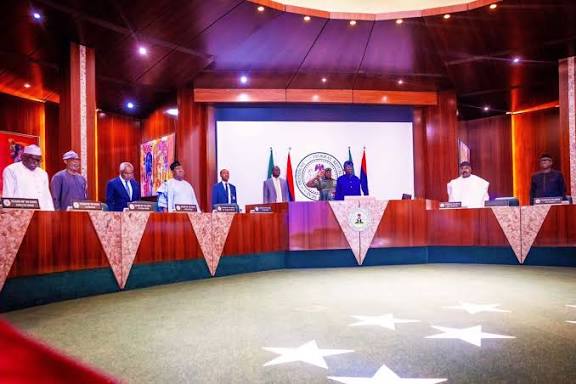

The Federal Executive Council (FEC) on Wednesday approved the 2026–2028 Medium-Term Expenditure Framework (MTEF), charting Nigeria’s fiscal path over the next three years.
Presenting the plan, Atiku Bagudu, Minister of Budget and National Planning, said the framework was jointly developed by the Budget Office and his ministry, with input from the private sector, civil society, and development partners.
Under the approved framework, the federal government expects a total federation revenue of about ₦50.74 trillion in 2026, distributed among the federal, state, and local governments.
Of this, the federal share alone is estimated at ₦22.6 trillion, with states receiving ₦16.3 trillion and local governments ₦11.85 trillion.
However, once projected transfers, debt-servicing cost and overheads are taken into account, the plan estimates total net federal revenue at ₦34.33 trillion — a drop of roughly 16 per cent compared to the 2025 estimate.
Concomitantly, expenditures including statutory transfers, debt servicing, personnel and recurrent costs are expected to push the fiscal deficit to ₦20.1 trillion, equivalent to about 3.61 per cent of GDP.
To anchor the projections, the MTEF assumes a conservative oil price benchmark of US $64–65 per barrel, oil production of 1.8 million barrels per day (though the target remains 2.06 million bpd), and an exchange rate of ₦1,512 to the dollar.
The government emphasized that this cautious approach aims to guard against volatile oil markets and macroeconomic shocks, especially in an election-year environment.
President Bola Tinubu directed that capital spending under the MTEF be strictly channelled into growth-enhancing infrastructure, human capital development, security and transformative projects — stressing efficiency, fiscal discipline and maximizing value per naira.
With the MTEF now approved, the administration is set to finalize the 2026 Appropriation Bill and transmit it to the National Assembly, marking the next step toward translating the fiscal framework into actual budget allocations.











Comments