
Fintech and other commercial banks to charge 7.5% VAT on Transfers, USSD Payments


Nigeria’s financial landscape is set for a noticeable shift as the Federal Government has directed all commercial banks, microfinance banks and fintech platforms to begin charging and remitting a 7.5 per cent Value‑Added Tax (VAT) on selected electronic banking service fees, a move that will start from Monday, January 19, 2026.
The directive, communicated to customers through email notices from payment providers such as Moniepoint, makes it mandatory for financial institutions to collect VAT on service charges linked to mobile bank transfers, USSD transaction fees and card issuance fees. Importantly, the tax is applied only to the service fee and not to the actual amount being transferred by the customer. meaning if a bank charges ₦100 for a transfer, an extra ₦7.50 VAT will be added to that fee before remittance to the Nigeria Revenue Service (NRS).
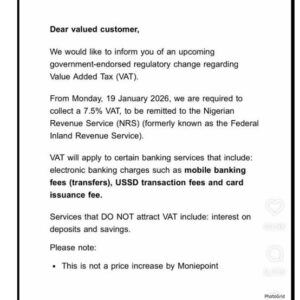
The NRS, which replaced the Federal Inland Revenue Service (FIRS), has stressed that the implementation is not the introduction of a new levy but enforcement of existing tax rules requiring uniform VAT collection across digital services. According to the revenue authority, VAT has long applied to fees, commissions and charges imposed by banks and fintechs for services rendered, and the Nigeria Tax Act did not introduce a new tax obligation on customers under this regime. The NRS further clarified that interest earned on savings, deposits and similar earnings remains exempt from VAT, as such income is not considered a taxable supply of goods or services.
The government’s move to standardize VAT collection on digital financial services reflects efforts to align tax compliance with the rapid growth of Nigeria’s digital economy and broaden the country’s revenue base. Financial institutions are expected to clearly itemize the VAT on customer transaction statements, ensuring transparency in how the tax is applied. Observers note that, while VAT on banking fees is not entirely new, the enforcement of uniform collection — especially by fintech operators that have rapidly expanded mobile and USSD banking — is likely to affect how everyday Nigerians perceive and use digital financial services.
Consumer groups and associations have raised concerns, with the Agents Association of Nigeria arguing that the 7.5 per cent VAT could amount to double taxation for users who already pay for airtime and data to perform USSD transactions. As the effective date approaches, criticism and debate over the fairness and impact of the charge are mounting, with industry voices urging clearer communication from authorities to avoid public confusion over what exactly is being taxed.
Banks and tech‑driven financial service providers are preparing to implement the directive, and customers across Nigeria should expect to see the VAT reflected in their electronic banking charges from January 19, 2026, as part of a broader push to formalize taxation in line with the expansion of digital financial transactions nationwide.
Read Also:
- Hidden Bank Charges You Might Not Know
- Why Nigerian Banks Deduct ₦50 Naira From Transfers
- SMS Alert charges in Nigeria | How to stop them











Comments