Investment Climate Heats Up: Lagos Leads States in 2025 Business Reform Index


In a landmark development for Nigeria’s investment climate, Lagos tops Nigeria’s ease of doing business ranking for 2025, with Kaduna and Oyo states trailing closely in the newly released Subnational Ease of Doing Business (EoDB) Report.
The annual ranking, published by the Presidential Enabling Business Environment Council (PEBEC), provides the most comprehensive assessment yet of how well Nigeria’s 36 states and the Federal Capital Territory are improving conditions for business and investment.
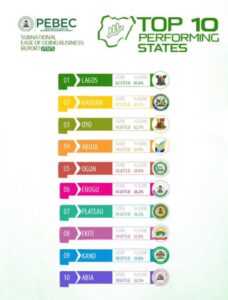
Lagos State emerged as the best-performing state nationally, scoring 85.6% overall in the 2025 EoDB assessment.
This leading position underlines Lagos’s continued role as Nigeria’s economic powerhouse and most attractive investment destination.
Analysts attribute Lagos’s strong performance to consistent reform implementation, infrastructure investments, regulatory digitisation, and effective administration.
Lagos’s top ranking reflects improvements across multiple economic and regulatory indicators, such as land administration, trade logistics, taxation process efficiency, and investor services.
- Kaduna State Secures Second Place
Kaduna State ranked second best in the national EoDB rankings, with a commendable 65.1% score.
State officials, including Governor Uba Sani, described the ranking as proof of Kaduna’s growing investor-friendly environment and success in structural reforms.
The state’s performance underscores improvements in areas like infrastructure, digital connectivity, commercial justice efficiency, and manpower readiness, which have collectively boosted its competitiveness.
- Oyo State and Others in the Top Five
Oyo State took third place, followed by the Federal Capital Territory (FCT) and Ogun State, rounding out the top five.
This grouping signals additional regional hubs where policy and administrative reforms are beginning to yield tangible results for business owners and investors.
Additional states in the extended top 10 include Enugu, Plateau, Ekiti, Kano, and Nasarawa, signaling pockets of progress across diverse geopolitical zones.
Understanding the EoDB Framework
The 2025 Subnational Ease of Doing Business Report is a data-driven evaluation covering 16 key indicators and 36 sub-metrics, including:
- Electricity and infrastructure reliability
- Digital connectivity and ICT adoption
- Land administration ease
- Taxation processes
- Trade logistics and justice delivery
- Access to investor support and skilled labour readiness
These metrics provide investors and policymakers with clear insights into operational bottlenecks and reform successes at the state level.
What This Means for Investors
Boosting Foreign and Local Investments
Lagos’s dominant position coupled with improvements in Kaduna and Oyo enhances Nigeria’s attractiveness to both local entrepreneurs and foreign investors. Market participants highlight that consistent improvements in regulatory transparency and infrastructure can significantly reduce operational costs and risk.
Policy Implications for States
PEBEC’s detailed scoring also included recommendations that states can implement immediately to improve competitiveness further. These include:
- Developing investor aftercare systems
- Strengthening access to credit for micro, small and medium-sized enterprises (MSMEs)
- Standardising interstate trade rules
- Modernising commercial justice mechanisms
- Improving electricity reliability in industrial clusters
Experts say adoption of these reforms could widen investment opportunities and nurture sustainable economic growth across Nigeria.
Challenges and Areas for Improvement
Despite Lagos’s success, persistent challenges remain:
- Digital connectivity gaps and limited broadband coverage continue to constrain business productivity in many regions, especially outside major cities.
- In several states, progress on infrastructure and administrative efficiency remains uneven, contributing to underperformance in investment attraction.
These challenges highlight the need for sustained policy focus on infrastructure, technology adoption, and regulatory predictability to foster a competitive and inclusive business environment nationwide.
Conclusion
The 2025 Ease of Doing Business ranking clearly positions Lagos State at the forefront of Nigeria’s investment landscape, followed by Kaduna and Oyo, reflecting the impact of strategic reforms and governance improvements at the subnational level.
As states compete to attract capital, the EoDB framework is becoming an essential tool for shaping policy, guiding investment decisions, and driving economic transformation across the federation.










Comments