
Why Transfers Fail Even With Good Internet
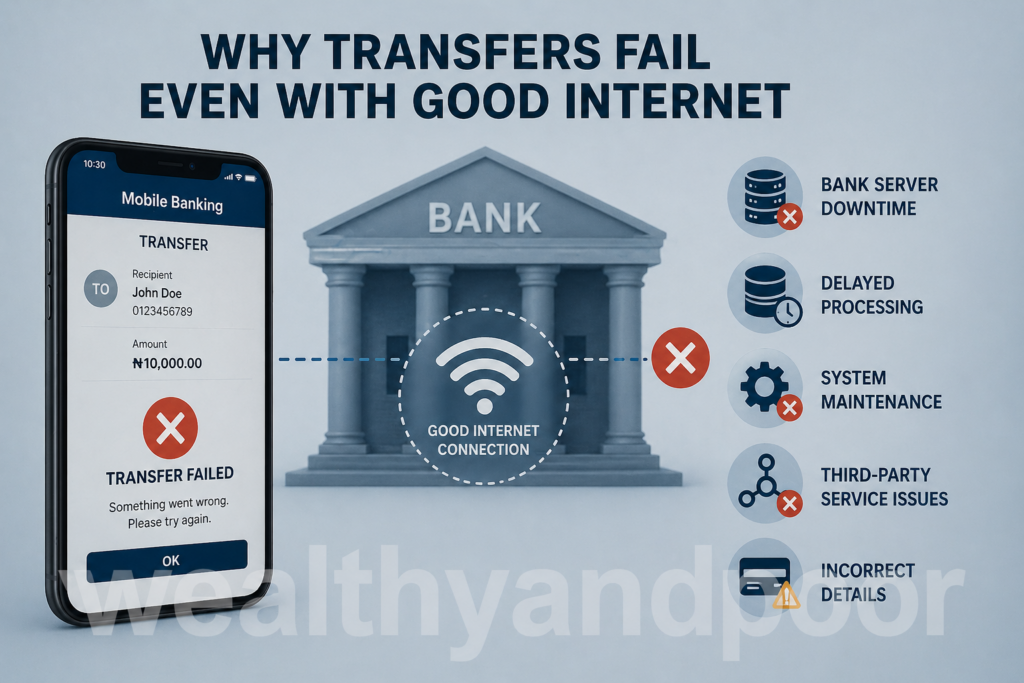

In today’s digital banking era, many Nigerians assume that a strong internet connection guarantees a successful bank transfer. After all, if your mobile data is fast and your signal is stable, what could possibly go wrong? Yet, the reality is far more complex. Across Nigeria’s banking ecosystem, transfers still fail even when everything seems perfect on the user’s end.
Understanding why this happens requires looking beyond your phone and into the deeper infrastructure that powers financial transactions.
The Illusion of “Good Internet”
A good internet connection only ensures one thing: that your device can communicate with your bank’s interface whether that’s a mobile app, USSD code, or internet banking portal. It does not guarantee that the entire transfer process will succeed.
A single transfer involves multiple systems working together in real time. These include your bank’s servers, interbank settlement platforms, and the receiving bank’s infrastructure. If any one of these systems fails or slows down, the entire transaction can break down even if your internet is flawless.
How Bank Transfers Actually Work
When you initiate a transfer, the process typically flows through several stages:
- Your request is sent from your device to your bank
- Your bank processes the request internally
- The transaction is routed through a central switch (like NIBSS)
- The receiving bank validates and credits the account
This multi step journey explains why failures can occur at different points. A disruption anywhere along this chain can result in a failed or delayed transaction.
Key Reasons Transfers Fail Despite Good Internet
- Bank System Downtime and Maintenance
Banks frequently update their systems to improve performance and security. These updates often occur during late nights, weekends, or off peak hours. During such periods, transfer services may be temporarily unavailable or unstable.
Even if your internet is working perfectly, the bank’s backend may not be ready to process your request.
- Central Infrastructure Failures (NIBSS Issues)
In Nigeria, most interbank transfers rely on a shared system called the Nigeria Inter Bank Settlement System (NIBSS). This platform connects different banks and enables instant transfers.
If NIBSS experiences congestion, delays, or technical glitches, transactions across multiple banks can fail simultaneously regardless of your network quality.
- High Transaction Volume and Server Congestion
Digital banking usage in Nigeria has grown rapidly. During peak periods such as salary days, evenings, or festive seasons millions of transactions are processed at once.
This surge can overwhelm bank servers, leading to:
- Slow processing
- Timeout errors
- Failed transactions
Your internet may be fast, but bank servers can still reject or delay your request due to overload.
- Interbank Communication Breakdowns
Transfers between different banks are more complex than transfers within the same bank. They depend on smooth communication between separate systems.
If the receiving bank’s server is slow, offline, or unresponsive, your transfer may fail even if your bank processed the debit successfully.
- Session Timeouts (Especially with USSD)
USSD banking works within a time-limited session. If you take too long to enter your PIN or confirm details, the session may expire.
This can cause:
- Transaction cancellation
- Debit without completion
- Error messages
Importantly, this happens even when your mobile signal is strong.
- System Synchronization Issues
Banks perform routine processes such as:
- Daily transaction limit resets
- End-of-day reconciliation
- System synchronization
Transfers initiated during these processes especially around midnight may fail due to temporary inconsistencies in the system.
- Backend Integration Problems
A transfer often involves third party processors, switching platforms, and APIs. If any integration point is slow or malfunctioning, the transaction may not complete.
These issues are invisible to users but are a major cause of failures in modern banking systems.
Common Misconceptions
Many users misunderstand how transfers work. Here are some common myths:
- “Good internet guarantees success”
False. Your network is only one part of a larger system.
- “Failed transfers mean lost money”
Not usually. Most failed transactions are automatically reversed within 24–72 hours.
- “The bank app is always to blame”
Not necessarily. Failures may originate from central systems or the receiving bank.
What Happens When a Transfer Fails?
A failed transfer typically means the transaction could not be completed successfully. Depending on where the failure occurred:
- Your account may not be debited at all
- Your account may be debited without the recipient receiving funds
- The transaction may remain pending
In most cases, the system initiates a reversal process, returning the funds within a few hours or days.
How to Reduce Transfer Failures
While you cannot control banking infrastructure, you can reduce your risk by:
- Avoiding peak hours (evenings, weekends, salary days)
- Making transfers during business hours when systems are more stable
- Double-checking recipient details before confirming
- Avoiding repeated retries immediately after a failure
Conclusion
The failure of bank transfers even with good internet is not a mystery once you understand the system behind it. Digital banking is not powered by a single connection but by a network of interconnected systems, each with its own vulnerabilities.
Your internet connection is just the starting point. Beyond that lies a complex ecosystem of bank servers, settlement platforms, and interbank communications all of which must align perfectly for a transfer to succeed.
Until these systems become more resilient and synchronized, occasional transfer failures will remain part of the digital banking experience in Nigeria.












Comments