
Kuda Bank Charges Explained
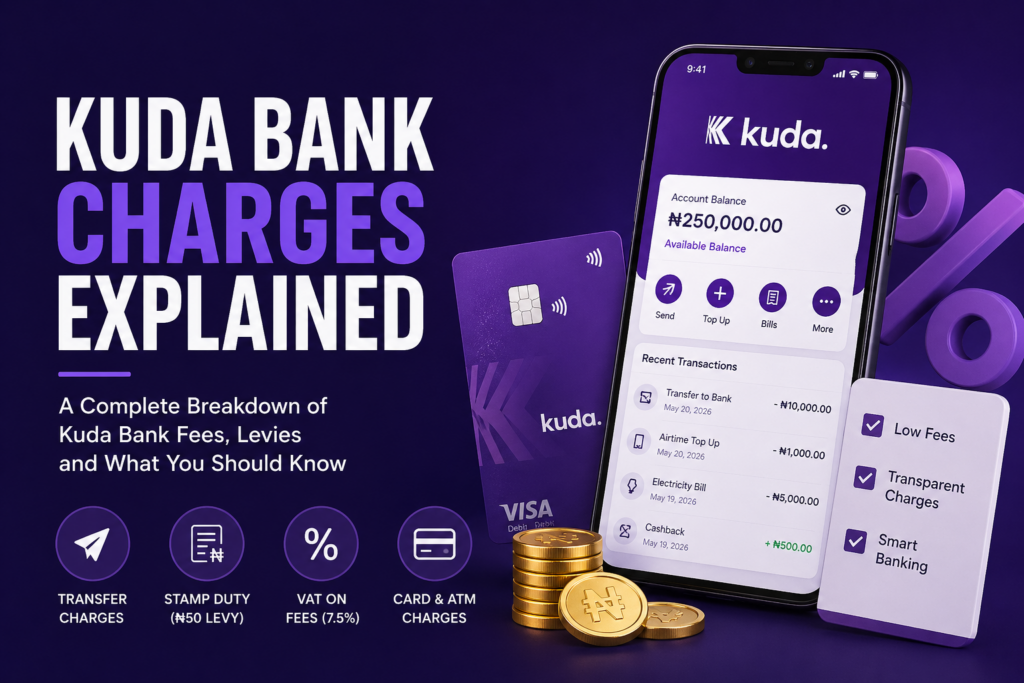

Digital banks like Kuda Bank have built a strong reputation around “zero charges.” But in reality, Kuda operates a low-cost model not a completely free one. Understanding how its charges work can help you avoid surprises and manage your money better.
Kuda is a mobile-first microfinance bank licensed by the Central Bank of Nigeria. It removes many traditional banking fees like:
- Account maintenance fees
- SMS alert charges
- Card maintenance fees
However, certain regulated fees and usage-based charges still apply.
Transfer Charges
Kuda is popular for its free transfer structure, but it comes with limits, 25 free transfers monthly to any Nigerian bank
After that ₦10 per transfer (below ₦1 million).
If you send money frequently (e.g., business owners or vendors), you’ll start paying small fees after exhausting your free quota.
Stamp Duty Charges
Stamp duty is a government-mandated charge, not controlled by Kuda, ₦50 applies to transfers of ₦10,000 and above. As of 2026 Sender start paying the ₦50 charge while Receiving money is now free.
Example: If you send ₦20,000, ₦50 stamp duty applies
It’s deducted from your account (not the receiver).
VAT on Banking Fees (7.5%)
January 2026, Nigeria introduced 7.5% VAT on banking service fees.
VAT is NOT charged on your money
It applies only to service fees (e.g., transfer charges)
Example: Transfer fee: ₦10 + VAT (7.5%): ₦0.75 = Total cost: ₦10.75
Other Possible Charges
While Kuda avoids many traditional banking costs, you may still encounter:
- Bill Payments & Airtime: Usually free or discounted, service providers may include small charges
- Overdraft & Loans: Interest applies on borrowed funds (if you use Kuda overdraft
- Business Accounts: Bulk transfers: about ₦10 per transfe
Many Nigerians assume Kuda is completely free but that’s not entirely accurate.Free banking applies only within limits
Charges begin when:
- You exceed free transfers
- Government taxes apply
- You use premium services
As industry analysis puts it: Kuda is “structured low-cost banking with limits.
Kuda Bank is not completely free but it is transparent, predictable, and significantly cheaper than traditional banks. The key is understanding your free limits, government-imposed charges, when fees start applying.
Once you know this, you can maximize savings and avoid unnecessary deductions.











Comments